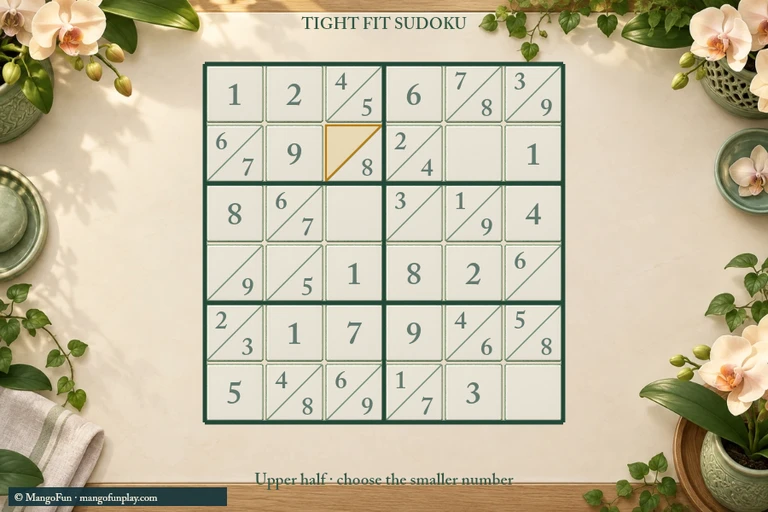
Play Ripple Effect Online
Play a Ripple Effect puzzle on a quiet illustrated water-garden table. Fill each outlined room with its own set of numbers, then give matching numbers enough space along their rows and columns. Ripple Effect has twenty original progressive challenges, pencil notes, candidate explanations and hints that show why a move follows. Play free online with no ads or download.
How to play Ripple Effect online
- Read the thick room boundaries. A room of four cells must contain 1, 2, 3 and 4 exactly once.
- Compare matching numbers along rows and columns. A value of 3 needs at least three cells between it and another 3.
- Use pencil notes and Explain to see which room or nearby number rules out a candidate. Diagonal repeats remain allowed.
- Fill every empty cell without a room duplicate or spacing conflict. Complete the challenge to unlock the next original puzzle.
Controls
Tap a cell or use the arrow keys, then type a number or select its button. P toggles pencil notes, E explains candidates, H requests a hint, C checks direct conflicts and U undoes. Clear removes an editable entry. Explain and Help open separately; close them to return to the board.
A tip before you start
Count the cells between matching numbers, rather than just the distance between their positions. Two 2s need two intervening cells, so the closest legal pair occupies positions three steps apart.
Every room has its own number set
A room's size determines its range. Three cells need 1–3, while six cells need 1–6. Every number in that range appears once in that room. Different rooms can have different sizes, and the grid's rows and columns do not have to contain every digit exactly once. The starting numbers are fixed clues.
A precise way to count the ripple
Equal values in the same row or column require at least that many intervening cells. A 1 can repeat two positions away because one cell lies between them. A 2 can repeat three positions away; a 3 can repeat four positions away. The cells between may contain other numbers. Diagonal neighbors do not trigger this rule. A repeated number inside the same room is still forbidden, however far apart its cells lie.
Explain the cell before choosing its number
Explain lists the digits available to the selected room and gives a reason for each exclusion. It identifies an existing digit in that room or a matching number whose row or column gap is too short. Candidates writes the numbers currently allowed by these local checks as pencil notes. An allowed local candidate can still lead to trouble elsewhere; it is not a guarantee of a complete solution.
See where a chosen value cannot repeat
Reach cycles through the selected room's values and an off setting. It shades the other cells in that room and the row or column positions too close for another copy of the chosen value. The preview applies to the selected cell as a hypothetical position; it does not enter a number or change your notes. Diagonal cells outside its room stay unrestricted.
Hints explain an elementary deduction
Each attempt has three hints. Before charging one, the game checks whether the current entries can be completed. A useful hint either finds a cell with one remaining candidate or a room where one number has only one possible home. It fills that number and opens its explanation. Inconsistent entries, a search limit or no elementary step leave the hint count unchanged. A search limit means unknown, not impossible. Undo restores the edit but does not refund a hint.
Twenty independently created puzzles
The four-by-four opening boards grow to five-by-five and six-by-six. Each challenge has a different original room layout and an independently verified unique solution. Empty cells increase from eight to twenty-eight, while the number of extra initially legal candidates rises from five to fifty-three, increasing the amount of elimination needed. These are structural measures, not a measured promise about every player's solving time. All twenty have a verified sequence of elementary room and spacing deductions.
Check, restart and save boundaries
Check highlights direct room duplicates and pairs with an insufficient gap. A clear check does not prove every entry is part of a solution. Undo restores numbers and notes together. Restart and level changes ask before replacing the attempt. Unlocked challenges, best scores and sound preference are saved locally; the unfinished board is not saved, so reloading starts a fresh attempt with those records retained. If storage is unavailable, progress lasts only for the session.
Ripple Effect and related number puzzles
Ripple Effect is a rule family published by Nikoli and also known as Hakyuu. The grids and artwork in Ripple Effect are original. This is a separate game from Sudoku, whose rows and columns prohibit every repeat, and from Tight Fit Sudoku, which places ordered pairs inside split cells. Those games retain their own rules and pages.
Frequently asked questions
Can two equal numbers touch diagonally?
Yes, unless they belong to the same room. Ripple spacing only applies within the same row or column; each room still uses every number once.
How far apart must two 3s be?
They need at least three cells between them, placing their positions at least four steps apart in a row or column.
Why does Check show no error when I am stuck?
Check finds direct rule violations. A locally legal choice can still prevent a full completion. Review its candidates, use Undo or ask for a hint.
Does Explain use a hint?
No. Explain describes local room and spacing restrictions without filling an answer. The separate Hint button can fill and explain one forced number, using one of three hints.
Are these puzzles copied from another collection?
No. All twenty grids were independently created for Ripple Effect. Nikoli is acknowledged as the publisher of the rule family; its sample puzzles are not used here.
About Ripple Effect
Play a Ripple Effect puzzle on a quiet illustrated water-garden table. Fill each outlined room with its own set of numbers, then give matching numbers enough space along their rows and columns. Ripple Effect has twenty original progressive challenges, pencil notes, candidate explanations and hints that show why a move follows. Play free online with no ads or download.
Play this puzzle / casual game in the embedded browser player. No app installation or MangoFun account is required. Follow the instructions shown inside the game; controls and device support depend on the title.