Play Dara Online
Learn the Dara board game through a complete computer match or 20 tactical studies. Place twelve stones each, then slide into rows of three and choose which opposing stone to remove. Dara uses a clearly stated classroom rules profile on a five-row, six-column board. Play free with no ads or download.
How to play Dara online
- In a full game, take turns placing one stone on an empty square until both players have placed twelve. A triple during placement earns no capture, and four in a row is forbidden.
- After placement, select a white stone and an adjacent empty square. Move horizontally or vertically, without jumping, flying or immediately reversing your previous slide.
- Form a new row of three to capture one black stone. You may remove any enemy stone in this profile, including one in a triple. Reduce the opponent to two stones to win.
Controls
Tap a white stone, then a highlighted destination. If the move forms a triple, choose a highlighted black stone to capture. Cancel choice reverses an uncommitted selection. Arrow keys move cell focus; Enter or Space uses it. H requests a hint, P plays a complete hint, S passes when blocked, and U or Ctrl+Z undoes. Help and Board & rules open separate dialogs. Pause, sound, restart and fullscreen controls are available.
A tip before you start
Count your open neighboring squares as well as your triples. A stone trapped behind your own line may be hard to use. Before making a capture, compare the opponent's possible replies: removing a connector can be more useful than taking the nearest stone. Remember that a direct return slide is temporarily forbidden.
A rectangular board with twelve stones each
The board contains 30 squares in five rows and six columns. You play White and the computer plays Black. A full match starts empty and chooses the first side from its starting seed. Each player places one stone per turn until both reserves are empty. White and Black board counts and remaining reserves stay visible throughout the match.
Placement triples and the no-four rule
Three adjacent stones of one color may form a horizontal or vertical line during placement, but that line captures nothing. Four or more consecutive stones of your own color are illegal in both placement and movement. Diagonal lines neither capture nor trigger the four-in-a-row restriction.
Slide one square and form a new triple
Once all 24 stones have been placed, move one stone to an adjacent empty square horizontally or vertically. There is no diagonal movement, jumping or flying when few stones remain. You cannot immediately move your last-slid stone straight back to its previous square. Board & rules records each side's last slide so this restriction is visible.
Choose one capture, even after two triples
A new triple at the destination earns one capture. Select any opposing stone, including a stone that belongs to an enemy triple. If your move creates two triples, you still remove only one stone. An unchanged triple from an earlier turn grants no extra capture. The move remains pending while you choose a target; Cancel choice or Undo can cancel it before anything is committed.
Blocked turns, winning and draws
A player without a legal action must pass. Blocking does not itself award a win in this teaching profile. After placement, a player reduced to two stones loses. This browser game draws after two consecutive compulsory passes, three occurrences of the same board with the same reserves, turn and last-slide restrictions, or 100 movement turns without a capture. A pass preserves the direct-return restriction. If a placement has no legal square, it also passes; these draw and placement edges are declared conventions.
Which Dara rules are used here?
Dara has several published profiles. This table allows placement triples without capture, forbids four in a row, permits capturing a stone in an opposing triple, prohibits an immediate reverse slide and skips a blocked turn. Other versions protect stones in triples or award a win when the opponent cannot move. The rules shown here govern both the computer match and the studies; they are not a claim that every traditional table plays identically.
Twenty studies with deeper planning
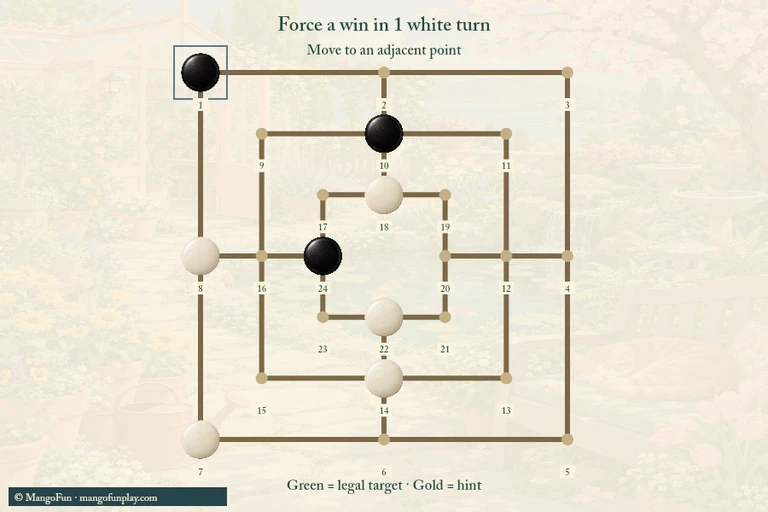
Studies begin at positions reached through legal full games. Force White's win within the displayed number of White turns. Each starting position has been independently checked against every legal opposing reply. Shortest winning plans increase from one to three turns, and the number of reachable planning states rises at every level. A capture target is part of your turn, not a free extra move. A wrong slide or capture can leave no forced continuation inside the remaining budget.
Hints, Undo and local progress
Study hints search the actual current position. A successful hint outlines a complete slide and capture; you may make it manually or press Play hint. Two successful hints are available per study, and Undo does not refund them. A search limit is reported as unknown. Full-match advice and computer play use a bounded, beatable board search. Undo cancels a pending capture first; otherwise it restores your last committed turn and the computer reply. Confirmed Restart repeats the seed, while New match chooses another. Only unlocks, best study results and sound preference save locally; unfinished boards restart after reloading.
Frequently asked questions
Can I capture while placing my twelve stones?
No. Placement triples are legal but earn no capture. Captures begin only after both players have placed all twelve stones.
Can I take a stone from the opponent's triple?
Yes, in this chosen profile. Every enemy stone is an eligible target after you create a new triple. Some other Dara rule sets protect opposing triples.
Why can I not slide straight back?
Your last-moved stone cannot immediately return to its previous square on your next actual slide. Move a different stone or choose another legal destination. A pass does not clear the restriction.
Does a row of four capture anything?
No. Creating four or more consecutive stones of your color is illegal here, rather than a larger capture.
What happens when both players are blocked?
The first blocked player passes. Two consecutive compulsory passes end this browser game in a draw.
Is this the same as Nine Men's Morris?
No. Dara uses a rectangular 30-square board, twelve stones per side and no placement captures. This version also has no flying and permits capturing any enemy stone.
Can I play another person online?
This version has a computer opponent and solo tactical studies. It has no remote matchmaking, shared rooms or cash stakes.
About Dara
Learn the Dara board game through a complete computer match or 20 tactical studies. Place twelve stones each, then slide into rows of three and choose which opposing stone to remove. Dara uses a clearly stated classroom rules profile on a five-row, six-column board. Play free with no ads or download.
Play this puzzle / casual game in the embedded browser player. No app installation or MangoFun account is required. Follow the instructions shown inside the game; controls and device support depend on the title.