Garden Card Golf lets you learn two versions of the low-score card game by playing them. Choose six-card or nine-card Golf for a nine-hole match against the computer, or work through 20 prepared Study Challenges. Our rules for the Golf card game with 9 cards use row and column triples, while the six-card version cancels matching vertical pairs. Play free online with no ads or download.
Choose a six-card or nine-card computer match, or start the prepared Study Challenges. In a full match, turn over two of your six cards or three of your nine cards to begin.
On your turn, take the visible discard or draw from the stock. A card taken from the discard must replace one of your grid cards; a stock draw may replace a card or go straight to the discard.
Keep your total low. Six-card Golf cancels equal-rank vertical pairs; nine-card Golf cancels equal-rank triples in a complete row or column. Matching point values alone do not count.
Follow the ending rule for the selected version, then compare scores. Full matches add the scores from nine holes. Study Challenges ask you to meet the displayed score target.
Controls
Use Draw stock or Take discard, then click or tap a grid card to replace. Previous, Next card and Select also work, with arrow keys for focus, S for stock, D for discard, X to discard a stock draw, U for Undo and H for Hint. Escape clears selection but keeps an already drawn card pending. In a study, normally hidden cards and the upcoming draw are disclosed as learning information; an H badge marks a card that is still hidden under normal rules, and actual face-up states still determine when the hole ends. A full match keeps unrevealed cards hidden.
A tip before you start
Check the whole column or row before replacing a card. A King is worth zero, but swapping it into an existing matching group can break a cancellation and raise your total. In six-card Golf, a pair of twos cancels to zero even though two separate twos would be worth minus four. In nine-card Golf, twos are ordinary two-point cards and Jokers are worth minus two.
Golf card game rules: 6 cards
This version uses one standard 52-card deck without Jokers and two rows of three cards for each player. Aces score 1, twos score −2, cards 3–10 score their face value, Jacks and Queens score 10, and Kings score 0. Equal ranks in a vertical pair score 0 together; horizontal and diagonal pairs do not cancel. Replacements stay face up. The first completely face-up grid ends the hole immediately, with no extra opponent turn.
Golf card game rules: 9 cards
The nine-card version uses 52 cards plus two Jokers and a 3×3 grid for each player. Aces score 1, cards 2–10 their face value, Jacks and Queens 10, Kings 0 and Jokers −2. A complete equal-rank horizontal or vertical triple scores 0. Diagonals and pairs do not cancel, and cancelled cards remain in the grid. This is a stated family version of Golf; other households use different scoring and ending rules.
How to play the Golf card game with 9 cards
Reveal any three cards at the start. Before drawing, you may make one opening reposition: move a revealed card that matches another revealed card by swapping it with a different grid position, only when that places the matching cards in the same row or column. Each swapped card keeps its face-up or hidden state, so this does not reveal a hidden card. You may skip this option. During play, choose the stock or visible discard, then replace a grid card, or discard a stock draw without an extra reveal.
Ending a hole and running out of stock
For this nine-card family profile, the first fully revealed grid triggers one final turn for the other player and then one for the triggering player. Already complete grids do not restart that sequence. In either profile, consuming the last stock card ends the hole after the drawn card has been replaced or discarded; remaining cards are exposed and scored. This stock-out boundary is our explicit house rule for six-card Golf. There is no reshuffle, and stock-out takes priority over an unfinished nine-card final-turn sequence.
Twenty increasingly demanding Study Challenges
The first ten lessons use six-card Golf; the next ten use nine-card Golf. These are prepared, reachable positions from complete deals, with upcoming draws and normally hidden cards disclosed for study. Later lessons require longer sequences of meaningful choices and more competing scoring decisions. Each starting position has a verified route to its displayed score target against the specified computer policy. That does not promise victory over every opponent or with every shuffled deck.
Nine-hole computer matches
Full matches deal hidden shuffled cards and play nine holes, alternating the first player each hole. The lower cumulative score wins; equal totals are a tie. The computer chooses using revealed information and the remaining card distribution, without looking at your hidden cards or the stock order. A visible subtotal during a hole is not the final score. Full matches are separate from Study Challenge unlocks.
Practice help and saved progress
Undo reverses your complete action and the computer response; undoing a pending draw restores the same top card. Study hints use the disclosed lesson information within a limited allowance; normal-match hints use public information, including a card only after it is drawn, and do not guarantee a win. If a bounded study hint search cannot verify a route, it reports that limitation. Challenge unlocks, best scores and sound preferences save locally when storage is available. Unfinished holes and matches are not restored after reloading.
Frequently asked questions
What are the rules for the card game called Golf?
The aim is a low card total across nine deals, called holes. In the six-card version here, matching ranks in a vertical column cancel; the nine-card family version instead cancels complete matching rows or columns and changes some card values. Choose a profile before playing and follow its setup, scoring and ending rules below. Four-card Golf and other household versions use different rules.
Are the six-card and nine-card scoring rules the same?
No. Twos score −2 in six-card Golf but 2 in nine-card Golf, which instead has −2 Jokers. Six-card Golf cancels vertical pairs; nine-card Golf cancels complete horizontal or vertical triples.
Do a Jack and Queen cancel because both score ten?
No. Cancellation requires equal ranks. A Jack and Queen both score 10, but they do not match each other.
Does discarding a stock draw reveal another grid card?
No. In these profiles, throwing away a stock draw does not automatically turn over a grid card. A card picked from the visible discard must be used as a replacement.
Does the first player to reveal everything always win?
No. The aim is the lowest score, not the earliest reveal. Ending a hole at the wrong time can leave you with a higher total.
Why can I see upcoming cards in Study Challenges?
Study Challenges are explicitly open-information lessons with prepared positions. Full computer matches keep the stock order and unrevealed cards hidden.
Do computer matches unlock the lessons?
No. Study Challenge progress is separate from full-match results. You unlock later studies by completing their preceding lessons.
About Garden Card Golf
Garden Card Golf lets you learn two versions of the low-score card game by playing them. Choose six-card or nine-card Golf for a nine-hole match against the computer, or work through 20 prepared Study Challenges. Our rules for the Golf card game with 9 cards use row and column triples, while the six-card version cancels matching vertical pairs. Play free online with no ads or download.
Play this puzzle / casual game in the embedded browser player. No app installation or MangoFun account is required. Follow the instructions shown inside the game; controls and device support depend on the title.
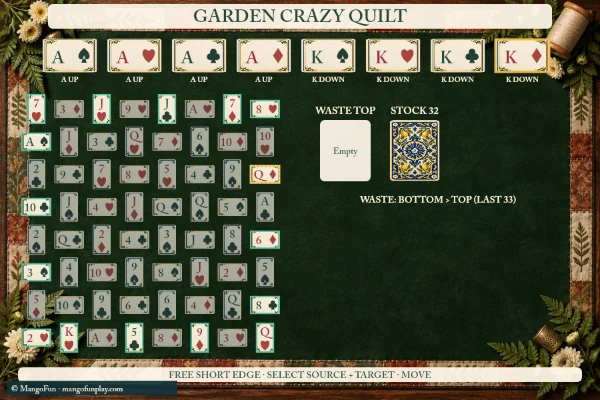
Play Crazy Quilt Solitaire on an illustrated garden table with a hand-sewn patchwork border. Sixty-four cards form a woven layout whose short edges control every move. Garden Crazy Quilt combines the full two-deck game with twenty original endgame studies about waste order, stock draws and the cards still in the quilt. Play free online with no ads or download.
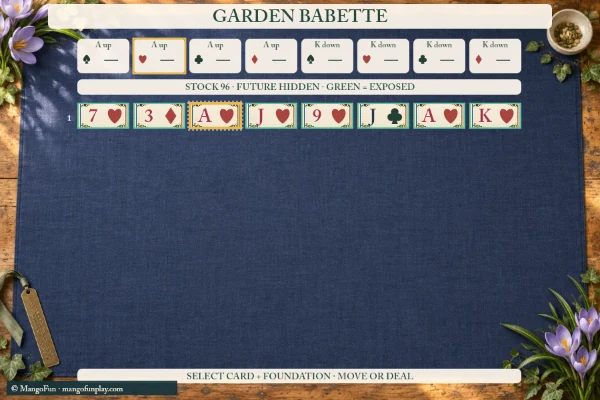
Play Babette Solitaire on an illustrated indigo garden table. Two decks feed eight suit foundations through aligned rows with lasting gaps. Garden Babette adds twenty original planning studies that compare moving a card with dealing the next row. Play free online with no ads or download.
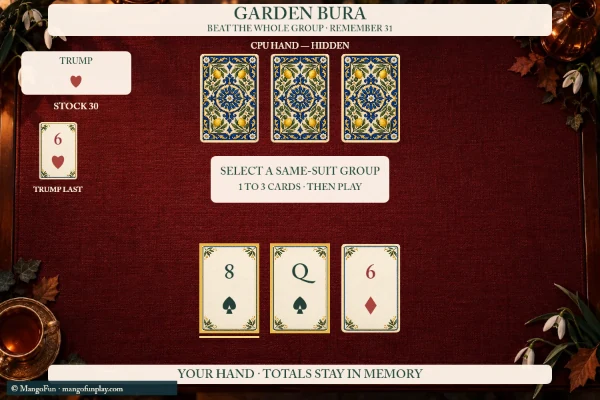
Play the Bura card game on an illustrated burgundy garden table. Lead several cards together, decide which tricks are worth taking, and remember when your captured points reach 31. Garden Bura combines a complete memory practice deal against the CPU with twenty original open planning studies. Play free online with no ads or download.
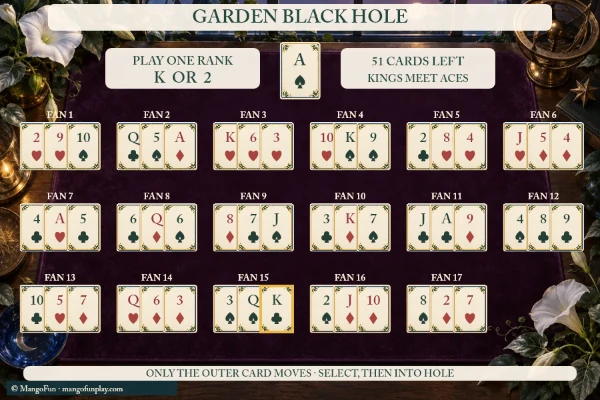
Play Black Hole Solitaire on an illustrated moonlit garden table. Seventeen open fans feed one central pile, one adjacent rank at a time. Garden Black Hole follows David Parlett's original single-deck rule profile and adds twenty original planning studies with exact explanations. Play free online with no ads or download.
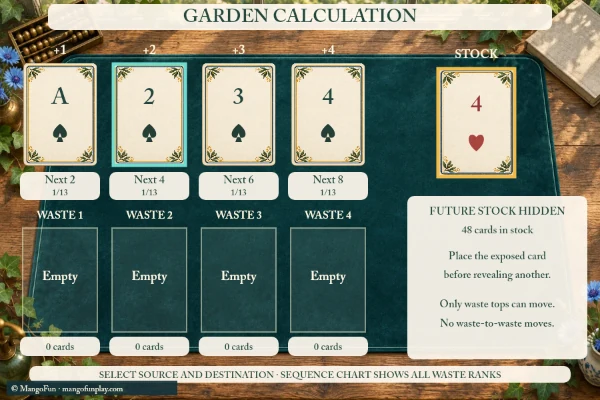
Play Calculation Solitaire on an illustrated teal garden table. Build four foundations by different rank intervals while planning where each stock card should wait. Garden Calculation includes full deals and twenty original open-stock studies with exact hint explanations. Play free online with no ads or download.
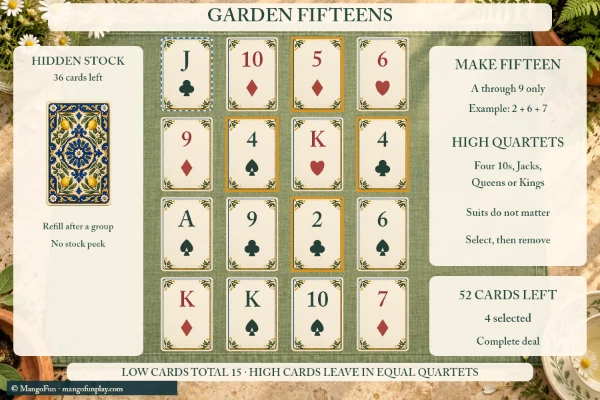
Play Fifteens Solitaire with illustrated cards on a chamomile garden table. Combine low cards to make fifteen, clear four equal high cards, and keep space for the next refill. Garden Fifteens uses the standard sum-and-quartet rules described below, with complete deals and twenty original planning studies. Play free online with no ads or download.