Play the Bura card game on an illustrated burgundy garden table. Lead several cards together, decide which tricks are worth taking, and remember when your captured points reach 31. Garden Bura combines a complete memory practice deal against the CPU with twenty original open planning studies. Play free online with no ads or download.
Choose a memory CPU deal, a fixed practice deck or an unlocked open study.
Lead one to three cards of the same suit, or reply with exactly the number of cards led.
Win the whole trick only if every lead card can be beaten by a different response card.
Remember captured points. Claim 31 when your total is high enough, or Continue to draw and play on.
Controls
Tap cards to add or remove them from your selection, then press Play group. Between tricks, Continue draws replacement cards; Claim 31 makes a separate declaration. Arrow keys move focus, Enter or Space toggles a card, P plays, C claims, H hints, U or Ctrl+Z undoes, and Escape clears. Details explains the current trick and lists exact study alternatives after a hint.
A tip before you start
To beat a two-card lead, you need two different cards that cover it. One strong trump cannot do both jobs. Before spending it, compare the points you would capture with the cards you would leave for your next lead.
A group must be beaten completely
A lead may contain one, two or three cards of a single suit. The response must contain the same number, but it can mix suits and does not have to follow the lead suit. A higher card of the same suit beats a lower one, and any trump beats a non-trump. To win a group, the response must cover every lead card separately. With hearts trump, the six of hearts and queen of spades can beat the king and seven of spades: the trump covers the king, while the queen covers the seven. If even one card remains uncovered, the leader wins the entire trick.
Ranks and point values serve different purposes
The deck contains thirty-six cards: Ace and six through King in each suit. From strongest to weakest, the order is Ace, Ten, King, Queen, Jack, Nine, Eight, Seven, Six. Aces count eleven points, Tens ten, Kings four, Queens three and Jacks two. The other ranks score nothing. A low trump can therefore win a valuable non-trump card without adding points of its own. Remember both the winner of a trick and the total value of all cards captured.
Remember the score and make a claim
A full memory deal conceals accumulated point totals and old captures. Both players see responses as they are played, and the current capture shows its value. After winning a trick, decide whether to claim at least thirty-one points or continue. Claiming is explicit; simply reaching the target does not press the button for you. The CPU remembers points it has seen and claims for itself. In this score-free practice version, a false claim loses the current deal. There are no stakes or gambling pots.
Replacement cards change the next decision
After the between-trick decision, cards are drawn alternately, beginning with the trick winner, until each hand is back to three. The face-up trump indicator is last in the stock. If there are too few cards for another complete draw pair, they remain unused. The winner then leads again. In memory mode, the opponent's hand and future draws stay hidden. Open studies display the remaining stock in draw order, so the choice of trick winner can be part of a longer plan.
The exact variant used here
Bura has several regional and combination variants. Garden Bura uses two players, thirty-six cards, face-up responses and the Bura-only combination option. A hand of three trumps wins before the next ordinary trick. If both players hold three trumps, their complete groups are compared, with the previous leader going first. Three aces and Molodka do not take the lead or win automatically in this profile. The game does not use Georgian twenty-card bidding or Kozel's four-card hands. Its score-free false-claim loss replaces a gambling stake penalty.
Twenty original studies with exact replies
Each study is a position reached through a complete legal deal history. Both hands, captured totals and future draws are deliberately visible. Force a win against the computer's exact replies, then make the required claim. The course grows from sixteen to eighteen cards still in hands, on the table and in stock, with one to four necessary meaningful decisions. Inferior alternatives in the solved game graph increase at every stage. These are planning measurements, not a promised human solving time.
Compare every legal alternative
A study hint selects an exact best continuation and records the outcomes of all legal alternatives in Details. A legal move may still let the opponent force a win. Three distinct positions may receive hints; returning to the same position reuses its result without another charge, including after Undo. A search reaching its budget is inconclusive and spends no hint. Retry CPU or Undo remains available. Full-deal suggestions use a simple public-information rule and neither count your remembered total for you nor guarantee a win.
Practice and save progress separately
Undo restores your action and the computer replies that followed, including draws and claims. It does not refund study hints. Restart repeats the starting deal; New deal and mode changes ask before replacing the current position. Study unlocks, best completion scores and sound settings save locally, while unfinished deals restart after reload. If storage is unavailable, progress lasts for the session. Help and Details open separately from the main table.
Frequently asked questions
Do I have to follow suit?
No. A response may contain any suits, but it must have the same number of cards as the lead. A lead containing several cards must use one suit.
Does beating one card win a two-card trick?
No. Each lead card needs its own stronger matching-suit card or eligible trump. Otherwise the leader takes every card.
What happens if I claim 31 too early?
The points are revealed and the current score-free practice deal is lost. Traditional stake penalties are not used here.
Does having three aces win?
Not in this selected variant. Only a three-trump Bura has the special combination privilege.
Can I inspect my old captured cards?
Memory mode keeps them closed. Open studies reveal accumulated totals to support planning, and all totals are revealed when a deal ends.
Is the computer using my hidden hand?
The full-deal CPU receives only its own hand, public table information and its remembered points. Study mode intentionally exposes both hands and uses exact replies.
About Garden Bura
Play the Bura card game on an illustrated burgundy garden table. Lead several cards together, decide which tricks are worth taking, and remember when your captured points reach 31. Garden Bura combines a complete memory practice deal against the CPU with twenty original open planning studies. Play free online with no ads or download.
Play this puzzle / casual game in the embedded browser player. No app installation or MangoFun account is required. Follow the instructions shown inside the game; controls and device support depend on the title.
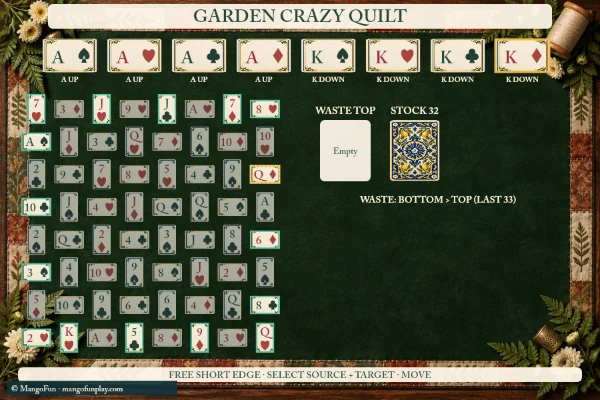
Play Crazy Quilt Solitaire on an illustrated garden table with a hand-sewn patchwork border. Sixty-four cards form a woven layout whose short edges control every move. Garden Crazy Quilt combines the full two-deck game with twenty original endgame studies about waste order, stock draws and the cards still in the quilt. Play free online with no ads or download.
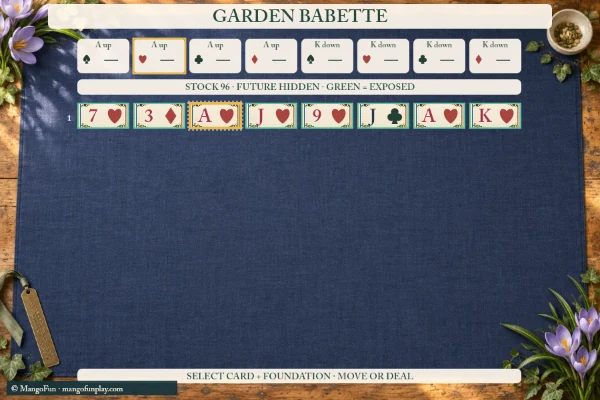
Play Babette Solitaire on an illustrated indigo garden table. Two decks feed eight suit foundations through aligned rows with lasting gaps. Garden Babette adds twenty original planning studies that compare moving a card with dealing the next row. Play free online with no ads or download.
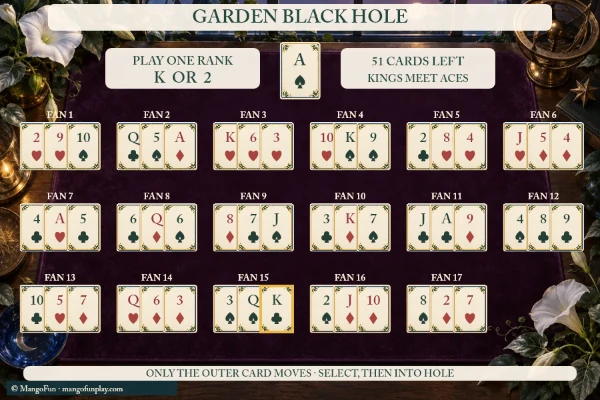
Play Black Hole Solitaire on an illustrated moonlit garden table. Seventeen open fans feed one central pile, one adjacent rank at a time. Garden Black Hole follows David Parlett's original single-deck rule profile and adds twenty original planning studies with exact explanations. Play free online with no ads or download.
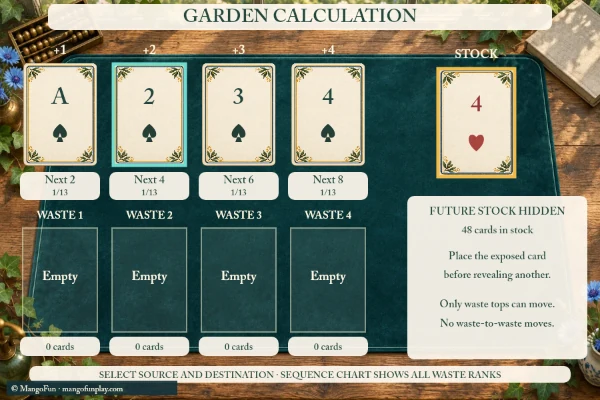
Play Calculation Solitaire on an illustrated teal garden table. Build four foundations by different rank intervals while planning where each stock card should wait. Garden Calculation includes full deals and twenty original open-stock studies with exact hint explanations. Play free online with no ads or download.
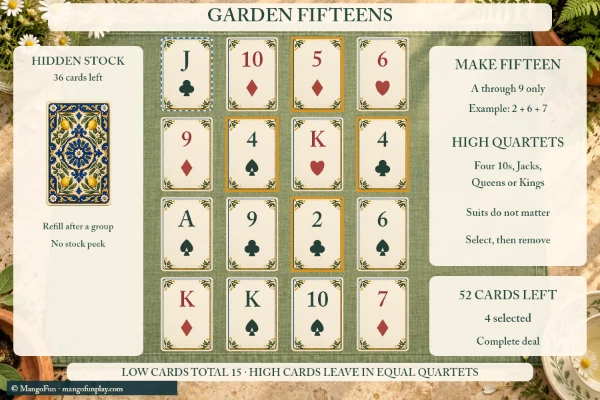
Play Fifteens Solitaire with illustrated cards on a chamomile garden table. Combine low cards to make fifteen, clear four equal high cards, and keep space for the next refill. Garden Fifteens uses the standard sum-and-quartet rules described below, with complete deals and twenty original planning studies. Play free online with no ads or download.
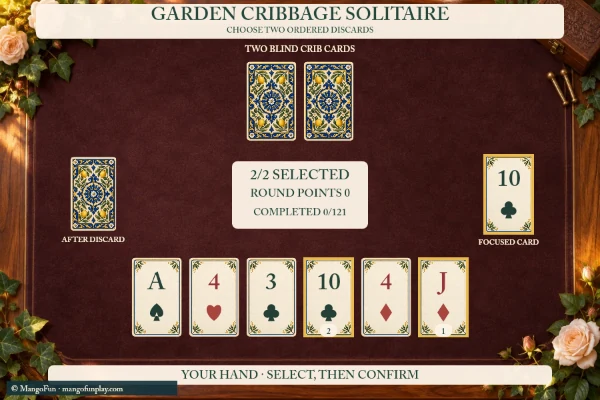
Play cribbage solitaire on a rosewood garden table, with an illustrated deck and a score breakdown after every round. This is the solo discard-and-pegging version contributed by Natty Bumppo to Pagat, using the automatic crib conventions explained below. Choose a complete six-round deck or twenty original open-card studies. Play free online with no ads or download.