Play cribbage solitaire on a rosewood garden table, with an illustrated deck and a score breakdown after every round. This is the solo discard-and-pegging version contributed by Natty Bumppo to Pagat, using the automatic crib conventions explained below. Choose a complete six-round deck or twenty original open-card studies. Play free online with no ads or download.
Choose a full six-round game, a guided opening or an unlocked study.
Select two discards in order. The second goes on top of the crib, then the starter is revealed.
Peg against the automatic crib without taking the running count above 31.
Review the hand and crib breakdown, then continue to the next round or replay your study.
Controls
Tap a card to select it. Choose two ordered cards before Confirm discards, or one card before Play card. Previous and Next card move the focus; Select / remove changes the selection. Arrow keys move the focus, Enter or Space selects, P confirms, H hints, U or Ctrl+Z undoes, and Escape clears. Score details, Help, Pause and Full screen are available beside the table.
A tip before you start
Count what a discard leaves in your hand as well as what it contributes to your crib. During pegging, a fifteen or a run may be more valuable than simply playing the highest card that fits. Only your pegging points count toward the solo target.
A complete deck, six rounds and a free crib
The game deals three cards to you, two unseen cards to the crib, and three more to you. Discard two of your six cards into the crib. The next stock card becomes the starter, with a Jack adding two points for heels. After pegging and the show, return the starter to the stock top so it is dealt in the next round. Six rounds use forty-eight cards. The final four make a free crib with the topmost discard from round one as its starter. Finish the deck with at least 121 points to win.
Follow the automatic crib order
You lead the first pegging count. Aces count one, numbered cards their face value, and court cards ten. The crib tries its two blind cards first, followed by your two discards in selection order. It plays the first card in that order that fits within 31. This first-playable convention keeps the fixed crib order compatible with the rule that a side must play when it can. The full game hides the blind cards, unrevealed starter and future stock.
Read the pegging score
Making fifteen or exactly 31 scores two. Consecutive matching ranks score two for a pair, six for three and twelve for four. A trailing group of three or more distinct consecutive ranks scores its length, even when those cards were played out of numerical order. A side with no card that fits passes automatically. The other side may continue, and the last card scores one unless it makes exactly 31. The other side starts the next count. The crib's pegging points are shown when relevant but are not added to your solo score.
Understand every show combination
Your kept hand and the crib each count with the starter. Every combination totaling fifteen scores two, every pair scores two, and every combination of the longest run scores that run's length. A four-card hand flush scores four, or five when the starter also matches. The crib earns a flush only when all five cards match. A held Jack of the starter's suit scores one for nobs. Score details lists the scoring cards after the round, so overlapping combinations are visible.
Know which solitaire rules are in use
Cribbage solitaire has several different rule sets. This page uses the six-round Natty Bumppo discard-and-pegging profile, with ordered discards, first-playable automatic crib cards and a returned starter. It does not use a two-hand 101-point deal, a 5×5 placement board or a tableau-to-31 game. The final free crib includes its starter and any Jack heels. Optional bottom-card peeking, an opposing deck score and muggins penalties are not part of this implementation.
Learn with twenty original open-card studies
Studies begin in legally reached positions from the last round of a complete deck. Normally hidden cards are deliberately visible. Reach the displayed score for this round, including points already earned; a study does not ask you to score 121 or win a whole deck. Available cards increase from two to six and necessary meaningful decisions from one to four. The solved decision graph has more inferior choices at each successive level. These measures order the course, while individual solving time may vary.
Compare an exact hint with your choice
A study offers three hints per attempt. Each completed search identifies a best action and its attainable round score. It selects or describes the action without committing it. If an earlier move has lost the target, Undo lets you revisit that decision. An inconclusive search uses no hint and does not decide the outcome. Full-game suggestions use only visible information and a simple heuristic, so they are advice rather than a guaranteed result.
Replay safely and keep your study progress
Undo reverses your last decision and the automatic crib replies, including newly counted round or free-crib points. It does not refund hints. Next round clears the previous round's undo history. Restart repeats the starting deck; a new deck, mode change or level change asks for confirmation. Study unlocks, best scores and sound preference save locally. An unfinished deck restarts after a reload. If storage is unavailable, progress lasts for the session.
Frequently asked questions
Is this ordinary two-player cribbage?
It uses familiar cribbage scoring, but you play alone against a fixed-order crib. Only your pegging points, your hand shows and the crib shows contribute to the solo total.
Why does the order of my two discards matter?
The automatic crib considers them after its two blind cards. The second discard also becomes the topmost used card, which supplies the free-crib starter when it comes from round one.
Why did a matching four-card crib earn no flush?
A crib flush needs all four crib cards and the starter to share a suit. The kept hand has the separate four-card flush rule.
Can the Score panel reveal hidden cards?
Hand and crib combination details appear only after the round. During play it reports the visible running score and the latest public actions.
What happens when neither side can stay under 31?
The final player receives one for last card, the count resets, and the other side leads if it has cards remaining. An exact 31 already earns two, so it receives no additional last-card point.
Can I replay an earlier study?
Yes. Unlocked studies stay in the level selector. Changing studies asks before replacing your current attempt.
About Garden Cribbage Solitaire
Play cribbage solitaire on a rosewood garden table, with an illustrated deck and a score breakdown after every round. This is the solo discard-and-pegging version contributed by Natty Bumppo to Pagat, using the automatic crib conventions explained below. Choose a complete six-round deck or twenty original open-card studies. Play free online with no ads or download.
Play this puzzle / casual game in the embedded browser player. No app installation or MangoFun account is required. Follow the instructions shown inside the game; controls and device support depend on the title.
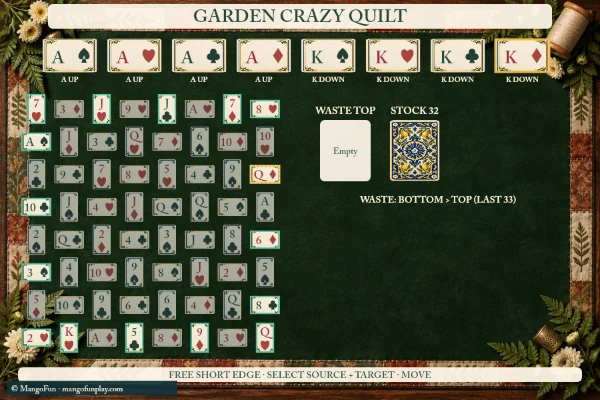
Play Crazy Quilt Solitaire on an illustrated garden table with a hand-sewn patchwork border. Sixty-four cards form a woven layout whose short edges control every move. Garden Crazy Quilt combines the full two-deck game with twenty original endgame studies about waste order, stock draws and the cards still in the quilt. Play free online with no ads or download.
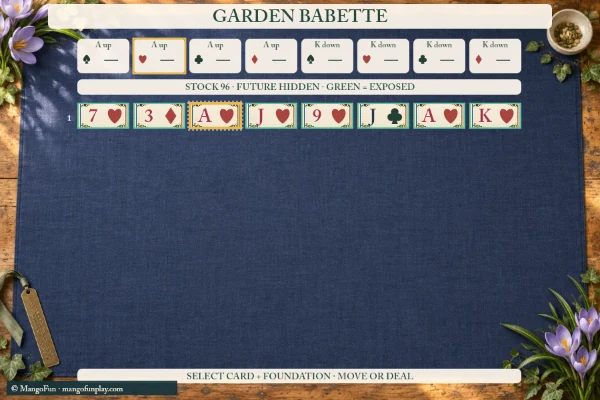
Play Babette Solitaire on an illustrated indigo garden table. Two decks feed eight suit foundations through aligned rows with lasting gaps. Garden Babette adds twenty original planning studies that compare moving a card with dealing the next row. Play free online with no ads or download.
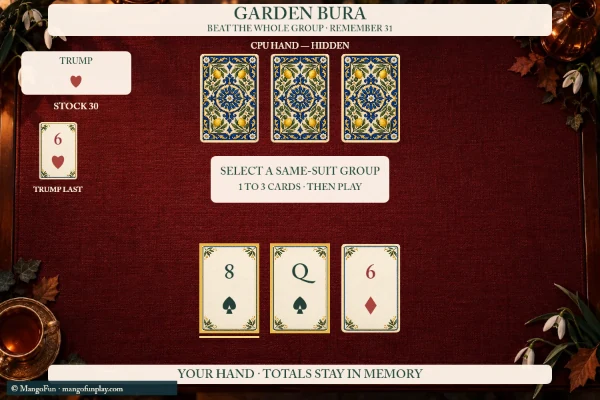
Play the Bura card game on an illustrated burgundy garden table. Lead several cards together, decide which tricks are worth taking, and remember when your captured points reach 31. Garden Bura combines a complete memory practice deal against the CPU with twenty original open planning studies. Play free online with no ads or download.
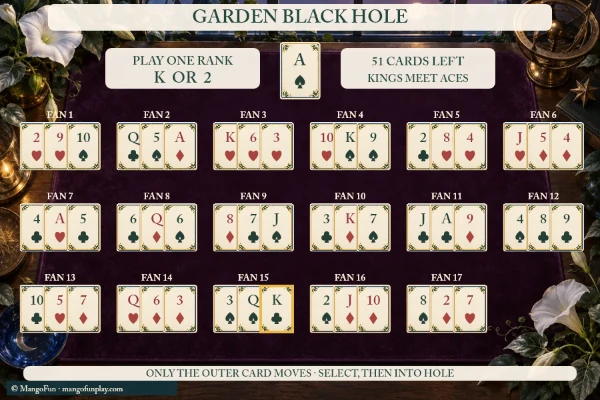
Play Black Hole Solitaire on an illustrated moonlit garden table. Seventeen open fans feed one central pile, one adjacent rank at a time. Garden Black Hole follows David Parlett's original single-deck rule profile and adds twenty original planning studies with exact explanations. Play free online with no ads or download.
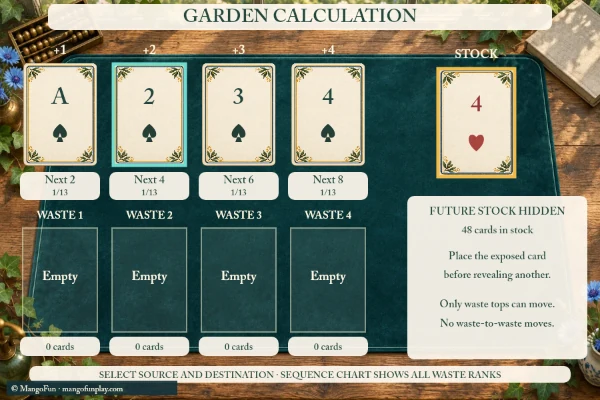
Play Calculation Solitaire on an illustrated teal garden table. Build four foundations by different rank intervals while planning where each stock card should wait. Garden Calculation includes full deals and twenty original open-stock studies with exact hint explanations. Play free online with no ads or download.
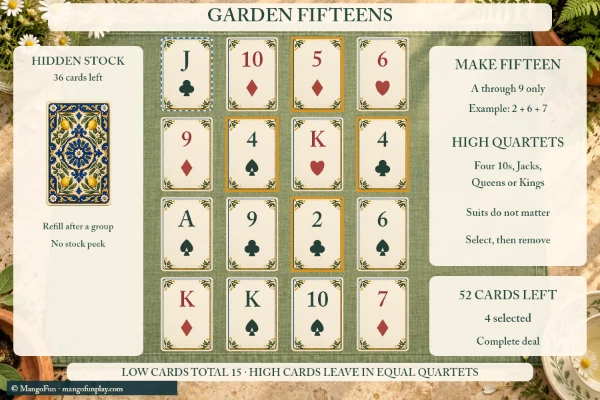
Play Fifteens Solitaire with illustrated cards on a chamomile garden table. Combine low cards to make fifteen, clear four equal high cards, and keep space for the next refill. Garden Fifteens uses the standard sum-and-quartet rules described below, with complete deals and twenty original planning studies. Play free online with no ads or download.