Play a Scopa card game with regular cards in Garden Scopa. Use familiar spades, hearts, clubs and diamonds to match a table card or capture a group with the same total value. Learn the scoring through 20 prepared, open-hand Study Challenges, or play a complete hidden-hand match against the computer. Play free online with no ads or download.
Choose Study Challenges or Full CPU Match. A full round deals three cards to each player and four to the table; the non-dealer plays first.
Select a hand card. If an equal-value single card is on the table, choose exactly one matching card. Only when no single card matches may you take a group adding up to the played card.
Use the highlighted capture, select table cards yourself, or cycle capture options. Press Play to confirm. With no legal capture, your card stays on the table.
Collect cards, diamonds, the seven of diamonds and strong primiera cards. Complete matches continue until someone has at least 11 points and a lead at the end of a round.
Controls
Click or tap a hand card, choose table cards and press Play. Previous/Next moves keyboard focus; Enter or Space selects a card. P plays, [ and ] cycle every legal capture, U undoes, H requests a hint and Escape clears your selection. The inspection bar separates capture value from primiera value. Score shows each scoring category. Help opens separately from the board.
A tip before you start
Before choosing the biggest capture, check the diamonds and sevens. A smaller capture can secure the seven of diamonds or improve a missing primiera suit. Also inspect what you leave behind: a table whose total is ten or less may offer the opponent a sweep.
How to play Scopa, the Italian card game
Play one hand card per turn. A matching single table card takes priority over any multi-card sum, even if the sum would collect more cards. When several single cards match, choose one; when several sums match and no single does, choose any one group. A chosen card must capture if it can, but you may instead choose a different hand card that cannot capture. Captured cards include the card you played.
Turn a regular 52-card deck into a Scopa deck
Remove all four 8s, all four 9s and all four 10s. Keep A–7, J, Q and K in each suit, for 40 distinct cards. Aces have capture value 1, Jacks 8, Queens 9 and Kings 10. Diamonds stand for the traditional coins suit. Garden Scopa displays court-card values on the cards so that a Jack is not mistaken for eleven.
A single card beats a possible sum
Suppose the table contains an Ace, a four and a five. Playing a five must capture the single five; you cannot choose the Ace plus four instead. If no single five were present, that pair would be a legal five-point capture. Two equal cards of different suits are separate choices because suit affects scoring.
Sweeps, new hands and the final play
Taking every table card earns one scopa point. The very last play of the round never earns a scopa, even if it naturally captures the whole table. When both hands empty, deal three more cards each from the stock without adding table cards. At the end, remaining table cards go to the last capturer without a sweep bonus. An opening table with three or four Kings is redealt.
Five scoring categories
Each scopa is worth one point. Most captured cards, most diamonds, the seven of diamonds and the best primiera each award one more point. Ties for a majority or primiera award neither player that point. Primiera takes your best captured card in each suit:7=21,6=18,A=16,5=15,4=14,3=13,2=12, and J/Q/K=10. Missing any suit makes you ineligible for primiera. These values are separate from capture values.
Study goals and full matches
Study Challenges show both hands in prepared, legally reachable endgames with an empty stock. Their targets are round point differences: a goal of 0 means preserve at least a round tie. Each starting position has a verified strategy against every legal opponent reply; it does not promise a complete match win. Planning depth never decreases, while distinct decision states and competing capture branches increase across the 20 lessons. Full matches use hidden shuffled cards, alternate dealer each round and continue through tied totals until someone has at least 11 points and a lead.
Hints, Undo and saved progress
Study hints use the disclosed hands and have a limited allowance. Full-match hints and the computer use only their own hand and public information, without reading the opponent’s hidden hand or future stock. That heuristic makes no optimal-play promise. Undo restores your full play and computer response, including deals and scoring; it restores the same random deal rather than rerolling it. Challenge unlocks, best scores and sound preferences save locally when storage is available. Unfinished rounds and matches restart after reload.
Frequently asked questions
Can I play Scopa with regular cards?
Yes. Remove the 8s,9s and 10s from a normal 52-card deck. Keep the court cards and use J=8, Q=9 and K=10 for captures; diamonds represent coins.
Why can I not take a sum when a single card matches?
Classic Scopa gives the matching single card priority. You may choose between equal single cards, but a multi-card sum becomes available only when there is no equal single card.
Does an Ace take everything?
No. This game uses classic Scopa: an Ace has capture value 1. It does not use the separate Ace-takes-all variant.
Is the final sweep worth a point?
No. The round’s very last played card cannot score a scopa. Collecting the remaining table at the end also earns no sweep point.
Why did I not receive the primiera point?
You need at least one captured card in every suit. Then compare the sum of the best primiera value from each suit; a tie awards neither player the point.
Do full matches unlock Study Challenges?
No. Study progress is separate. Complete the lesson’s displayed target to unlock the next one.
About Garden Scopa
Play a Scopa card game with regular cards in Garden Scopa. Use familiar spades, hearts, clubs and diamonds to match a table card or capture a group with the same total value. Learn the scoring through 20 prepared, open-hand Study Challenges, or play a complete hidden-hand match against the computer. Play free online with no ads or download.
Play this puzzle / casual game in the embedded browser player. No app installation or MangoFun account is required. Follow the instructions shown inside the game; controls and device support depend on the title.
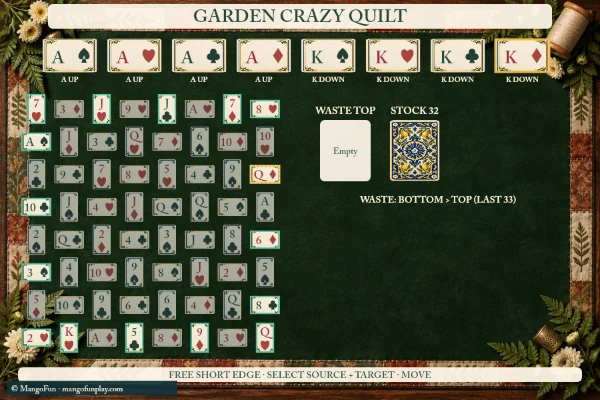
Play Crazy Quilt Solitaire on an illustrated garden table with a hand-sewn patchwork border. Sixty-four cards form a woven layout whose short edges control every move. Garden Crazy Quilt combines the full two-deck game with twenty original endgame studies about waste order, stock draws and the cards still in the quilt. Play free online with no ads or download.
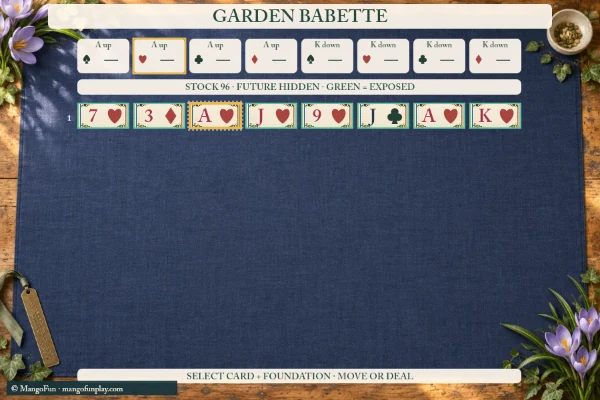
Play Babette Solitaire on an illustrated indigo garden table. Two decks feed eight suit foundations through aligned rows with lasting gaps. Garden Babette adds twenty original planning studies that compare moving a card with dealing the next row. Play free online with no ads or download.
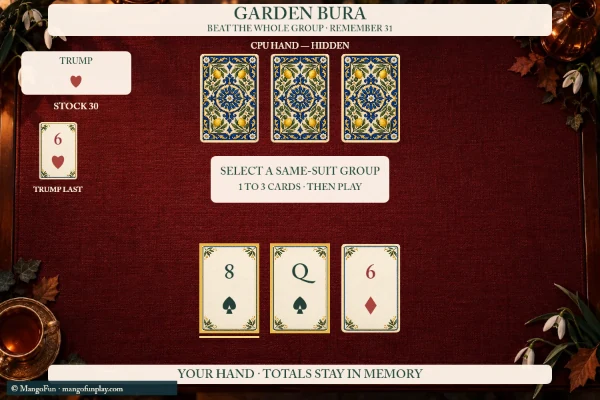
Play the Bura card game on an illustrated burgundy garden table. Lead several cards together, decide which tricks are worth taking, and remember when your captured points reach 31. Garden Bura combines a complete memory practice deal against the CPU with twenty original open planning studies. Play free online with no ads or download.
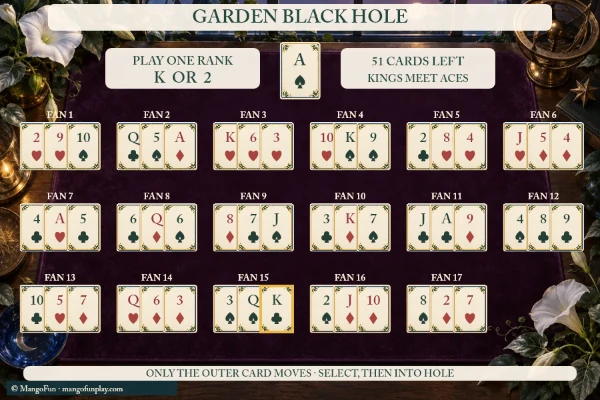
Play Black Hole Solitaire on an illustrated moonlit garden table. Seventeen open fans feed one central pile, one adjacent rank at a time. Garden Black Hole follows David Parlett's original single-deck rule profile and adds twenty original planning studies with exact explanations. Play free online with no ads or download.
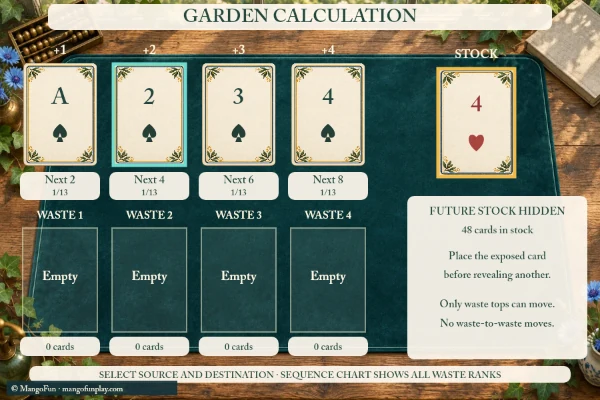
Play Calculation Solitaire on an illustrated teal garden table. Build four foundations by different rank intervals while planning where each stock card should wait. Garden Calculation includes full deals and twenty original open-stock studies with exact hint explanations. Play free online with no ads or download.
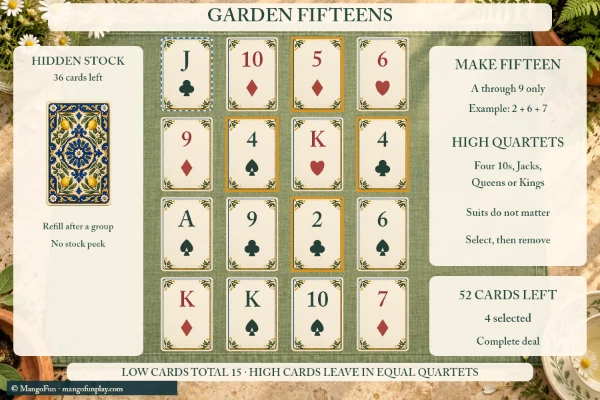
Play Fifteens Solitaire with illustrated cards on a chamomile garden table. Combine low cards to make fifteen, clear four equal high cards, and keep space for the next refill. Garden Fifteens uses the standard sum-and-quartet rules described below, with complete deals and twenty original planning studies. Play free online with no ads or download.