Play the Duck Soup card game on an illustrated pond-side table. David Parlett's two-player design changes from low-card tricks to high-card tricks, with matching ranks creating Quack challenges. Garden Duck Soup brings the rules into a computer match with a live scorecard and twenty original endgame studies. Play free online with no ads or download.
Choose a full computer match, a fixed guided opening or an unlocked open-hand study.
Select and confirm a card. Any suit may follow; matching the lead's rank announces Quack.
Read the current course: low led-suit cards win Duck, while high led-suit cards win Soup.
Review the product score after the deal, continue the match or complete the study's target margin.
Controls
Tap a card, then confirm with Play. Previous and Next card also select a card. Arrow keys move and select, Enter or Space selects the focused card, P plays, D chooses Duck, H requests a hint and U undoes. Score opens the course and match totals. Help, Pause and Full screen sit above the table.
A tip before you start
Watch the visible stock card during Duck, then check both course totals. Your final deal score multiplies them, so gaining another point in the course where you are already far ahead may be less useful than protecting your weaker course.
Read the two courses on the table
Each full deal starts with thirteen cards per player and a stock showing its top card. During Duck, winning a trick also wins that visible draw. The other player draws unseen. When the stock disappears, the table changes its course label and the remaining hand plays out as Soup. Aces are strong in either course: low in Duck and high in Soup. There is no trump suit or obligation to follow suit.
Use the labeled Quack controls
Playing the same rank as the lead declares Quack. The leader can press Duck to yield or select a third matching card for Quack-quack. The follower must then play a fourth card. A fourth matching rank captures both tricks; otherwise the original leader captures them. The Play button changes its label when your selection makes one of these calls. Calls are automatic on confirmation, so you never lose a trick for forgetting to speak.
Check the score before committing
A same-suit trick is worth one point and a mixed-suit trick is worth two. A four-card capture is worth three or four points, depending on its second pair. The score panel keeps Duck and Soup totals separate and displays each player's product. For example, eight Duck points and nine Soup points make seventy-two for that deal. The study target compares the two final products; it is not a target number of tricks.
Continue a full computer match
Completed deal scores accumulate toward 250. A single deal of at least125 earns a pond double-win, while losing a match with a total under125 is a double loss. Our implementation evaluates these outcomes at deal end. If both players make a pond, the higher deal score wins; an exact tie continues. Equal match totals at250 also continue. Next deal alternates the dealer and clears the undo history from the previous deal. New match asks before replacing your current session.
A clear replacement-draw convention
After an ordinary Duck trick, the winner draws first and the other player second. After a four-card capture, this implementation repeats that winner/loser sequence. If only two stock cards remain, each player draws just once and Soup starts with twelve cards per hand. This replacement order is an explicit implementation convention. The scorecard and course banner make the transition visible.
Twenty original open-hand studies
Study challenges begin after the stock has emptied, in positions reached through legal full-deck play. Both hands are visible by design. Aim to reach the stated final score margin against exact best responses. Remaining cards grow from two to six per hand, necessary meaningful decisions rise from one to five, and the number of inferior choices in the solved decision graph increases at each level. These measures guide the course order; personal solving time varies.
Compare a hint with your own plan
Each study attempt offers three hints. A successful hint names an action and the final margin it can guarantee against best replies. It does not play the card for you. If your earlier choice has lowered the attainable margin, the message points out the shortfall so you can Undo. A search that reaches its limit remains inconclusive, uses no hint and does not count as a loss. Full-match suggestions and the computer opponent instead use a simple public-information heuristic, without inspecting hidden cards.
Restart and save progress locally
Undo reverses your last action and its computer replies, including draws and any match totals just awarded. It does not refund study hints. Restart repeats the same starting seed; changing mode or starting a new match requires confirmation. Study unlocks, best scores and sound preference save in this browser. An unfinished match restarts after a reload. If storage is unavailable, progress lasts for the session. No account, betting or remote opponent is involved.
Frequently asked questions
Is Duck Soup the same as German Whist?
No. Both use a stock and a later hand-only phase, but this game has no trump or mandatory following suit. Its low/high course change, rank challenges and multiplied score give it different decisions.
Why can another suit win after a Quack?
A matching rank invokes the special Quack sequence. It can beat the led suit unless the leader counters with a third matching card.
Does the computer see my cards?
In full matches it receives only its own hand and public information. In studies both hands are intentionally shown, and the opponent solves the remaining position for its best response.
What happens if I score no points in one course?
Your deal product is zero, because one factor is zero. The two course totals are shown separately so you can watch that risk.
Can I replay a completed study?
Yes. Unlocked studies remain available in the level selector. Changing levels asks before replacing the current attempt.
About Garden Duck Soup
Play the Duck Soup card game on an illustrated pond-side table. David Parlett's two-player design changes from low-card tricks to high-card tricks, with matching ranks creating Quack challenges. Garden Duck Soup brings the rules into a computer match with a live scorecard and twenty original endgame studies. Play free online with no ads or download.
Play this puzzle / casual game in the embedded browser player. No app installation or MangoFun account is required. Follow the instructions shown inside the game; controls and device support depend on the title.
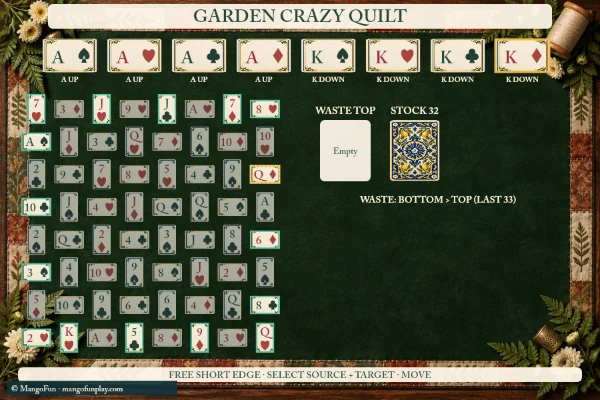
Play Crazy Quilt Solitaire on an illustrated garden table with a hand-sewn patchwork border. Sixty-four cards form a woven layout whose short edges control every move. Garden Crazy Quilt combines the full two-deck game with twenty original endgame studies about waste order, stock draws and the cards still in the quilt. Play free online with no ads or download.
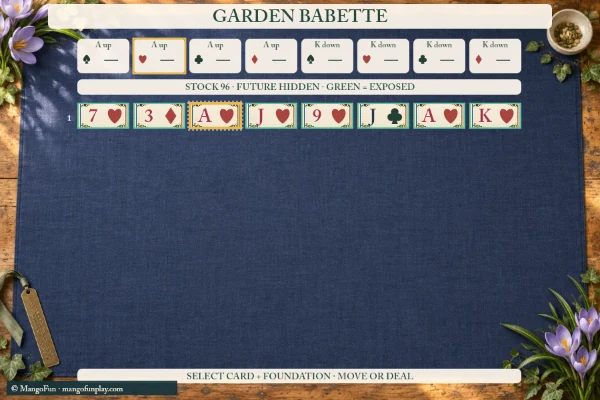
Play Babette Solitaire on an illustrated indigo garden table. Two decks feed eight suit foundations through aligned rows with lasting gaps. Garden Babette adds twenty original planning studies that compare moving a card with dealing the next row. Play free online with no ads or download.
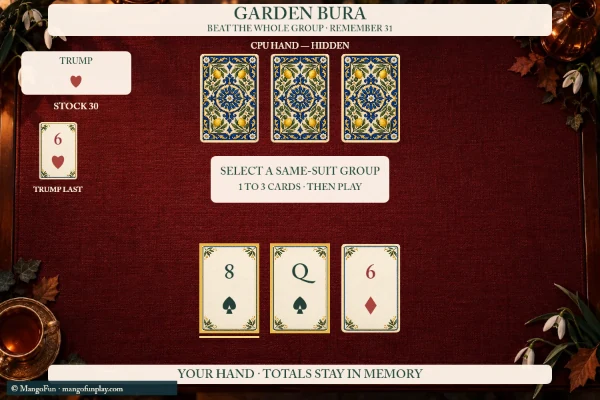
Play the Bura card game on an illustrated burgundy garden table. Lead several cards together, decide which tricks are worth taking, and remember when your captured points reach 31. Garden Bura combines a complete memory practice deal against the CPU with twenty original open planning studies. Play free online with no ads or download.
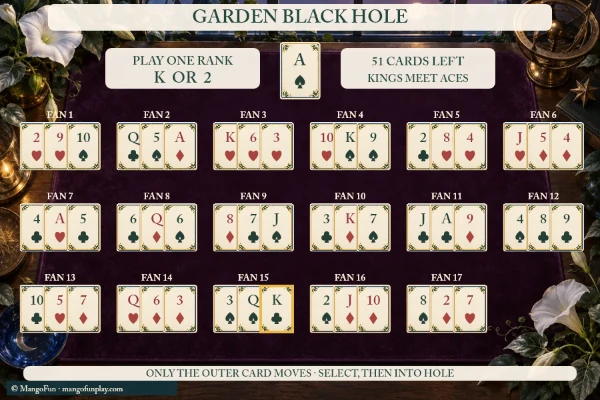
Play Black Hole Solitaire on an illustrated moonlit garden table. Seventeen open fans feed one central pile, one adjacent rank at a time. Garden Black Hole follows David Parlett's original single-deck rule profile and adds twenty original planning studies with exact explanations. Play free online with no ads or download.
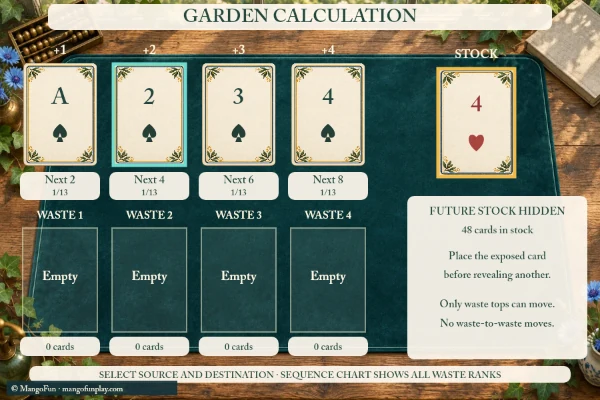
Play Calculation Solitaire on an illustrated teal garden table. Build four foundations by different rank intervals while planning where each stock card should wait. Garden Calculation includes full deals and twenty original open-stock studies with exact hint explanations. Play free online with no ads or download.
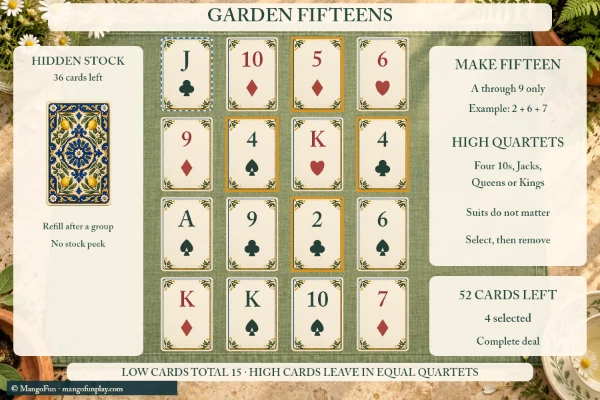
Play Fifteens Solitaire with illustrated cards on a chamomile garden table. Combine low cards to make fifteen, clear four equal high cards, and keep space for the next refill. Garden Fifteens uses the standard sum-and-quartet rules described below, with complete deals and twenty original planning studies. Play free online with no ads or download.