Learn piquet card game rules through a complete six-deal partie and 20 open endgame studies. Garden Piquet uses a 32-card Rubicon profile, combining a private exchange, declaration choices and no-trump trick play. Play free online with no ads or download.
Choose Full Six-deal Partie for a complete game against a local CPU, or Open Endgames for a visible scoring exercise. You control one hand in both modes.
In a full partie, decide whether to claim an eligible carte blanche, then select your discards. Elder exchanges one to five cards; younger exchanges one up to the remaining talon size. Exchange commits the selected cards.
Choose a point, sequence and set declaration. Use best proposes a collection; you may instead select a shorter collection or Sink it. Elder declares first; younger commits a reply, with younger’s points scored after the opening lead.
Follow the led suit if possible. A lead scores one point, winning the opponent’s lead scores another, and the final trick adds one. Finish the deal, then continue through the partie. In a study, preserve the displayed final score margin to unlock the next level.
Controls
Tap a card to select it. During exchange or declarations, another tap removes it from the selection. Arrows move focus, Space toggles a card, and Enter commits. H previews a hint, U or Ctrl+Z undoes, and C continues a finished deal. The large focused-card panel helps read a small hand. Records shows lawful declaration proofs, your discards, private elder peek and captured cards. Full-match CPU backs cannot be inspected.
A tip before you start
Plan the exchange around both declarations and trick control. A long suit can help the point contest, but keeping an entry to that suit may matter later. Before chasing a bonus, check whether the opponent has already scored in the relevant declaration order or actual play order.
Which piquet card game rules are used?
This game follows the 32-card Rubicon profile: two players, twelve cards each, eight in the talon, and ranks Seven through Ace. There are no trumps. A partie normally lasts six alternating deals. If the total is tied after six, play two more; a tie after eight is a draw. The displayed Rubicon result uses the losing score’s 100-point boundary. It is a points result, with no wagering or payments.
Exchange, carte blanche and private information
A hand initially containing no Jack, Queen or King may claim carte blanche for ten or leave it unannounced. When elder claims, both discard selections are committed before the elder hand is shown. An elder exchanging fewer than five gets the lawful private look at the unused part of the first five talon cards. Your own discards remain available in Records. Younger may expose any leftover talon after the opening lead. Opponent hands stay hidden except for information the rules allow.
Point, sequences, sets and sinking
The point contest compares the number of cards selected from one suit, then their face total. Sequences need at least three consecutive cards; sets need three or four equal ranks from Ten through Ace. Each category scores only for its winner; exact equality scores neither player. The winner can score the other selected combinations in that category. You may omit a collection or declare something shorter, but cannot raise a committed declaration after hearing the reply. In this interface younger commits the intended scoring collection when responding, then scores it after elder’s lead.
Pique, repique and the final tricks
Repique uses declaration category order: carte blanche, point, sequences, sets. Reaching thirty before the opponent’s declaration points adds sixty. Pique uses the actual scoring order and adds thirty when elder reaches thirty before the opponent has scored; the bonuses do not stack here. A lead and a capture of the opponent’s lead score separately. Winning more tricks adds ten, while taking all twelve gives forty instead. Those final majority or capot points cannot trigger pique.
Twenty endgames with increasing planning demands
Every study is a reachable position from a complete deal, with all thirty-two card identities retained. Both hands are visible, the CPU chooses exact strongest replies, and the target is a guaranteed final score advantage. Later studies leave more cards and increase distinct decision states and meaningful choices. The openings use maximum exchanges and declarations with carte blanche sunk; the studies focus on late-hand scoring and do not replace the full exchange and declaration interface.
Undo, hints and local progress
Undo restores the entire human action together with following CPU replies. Study hints preview a choice that keeps the target; spent hints stay spent after Undo. Losing the guarantee stops the study, with Undo available. Full-partie suggestions use lawful information and do not promise victory. Only study wins unlock levels. The browser saves unlocked studies, best scores and sound preference, but does not resume an active partie after reload.
A complete solo piquet card game
Full Partie handles exchange, declaration choices, all twelve tricks, six deals, the tie extension and the Rubicon result against one local CPU. Its modest strategy sees its own hand and legitimate public information only. This release does not offer remote multiplayer. Restart repeats the same start after confirmation; New partie starts a fresh game. Help, Pause, sound and optional full screen remain available.
Frequently asked questions
Can I learn piquet card game rules while playing?
Yes. Full Partie includes the exchange and declaration phases, with explanations in Help and Records. The twenty open endgames separately practice exact late-hand decisions.
Is this the six-deal or first-to-100 version?
It is the six-deal Rubicon profile. A tie adds two deals. First-to-100 and historical 36-card variants are not used.
May I hide a declaration?
Yes. Sink omits that category. You may also select a shorter valid collection. Once the opponent has replied, a committed declaration cannot be increased.
Why does younger score after the first lead?
The scoring order gives elder a point for leading before younger scores declarations. Repique still uses declaration category order, so it is checked separately from the actual order used for pique.
Does capot create a pique?
No. The forty-point capot bonus is applied after play. It does not count toward the thirty-point threshold for pique. The ordinary ten-point majority bonus is treated the same way.
Can the CPU see my hand?
In Full Partie its policy receives its own cards and lawful revealed information. In Open Endgames both hands are deliberately visible so the exact scoring target can be studied.
About Garden Piquet
Learn piquet card game rules through a complete six-deal partie and 20 open endgame studies. Garden Piquet uses a 32-card Rubicon profile, combining a private exchange, declaration choices and no-trump trick play. Play free online with no ads or download.
Play this puzzle / card / casual game in the embedded browser player. No app installation or MangoFun account is required. Follow the instructions shown inside the game; controls and device support depend on the title.
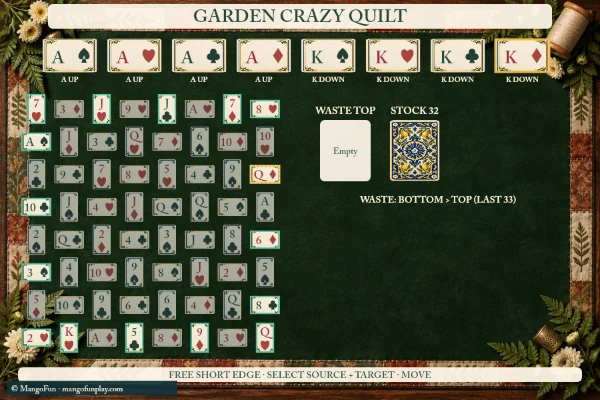
Play Crazy Quilt Solitaire on an illustrated garden table with a hand-sewn patchwork border. Sixty-four cards form a woven layout whose short edges control every move. Garden Crazy Quilt combines the full two-deck game with twenty original endgame studies about waste order, stock draws and the cards still in the quilt. Play free online with no ads or download.
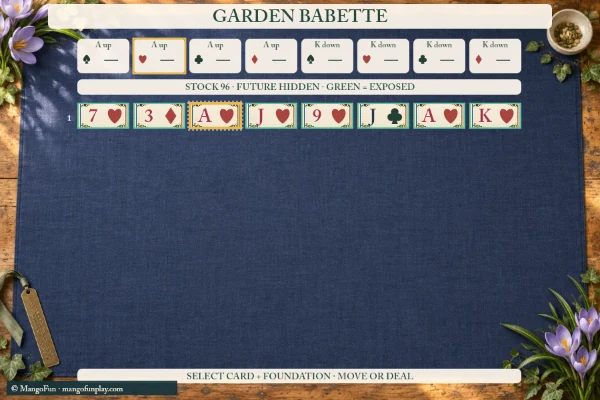
Play Babette Solitaire on an illustrated indigo garden table. Two decks feed eight suit foundations through aligned rows with lasting gaps. Garden Babette adds twenty original planning studies that compare moving a card with dealing the next row. Play free online with no ads or download.
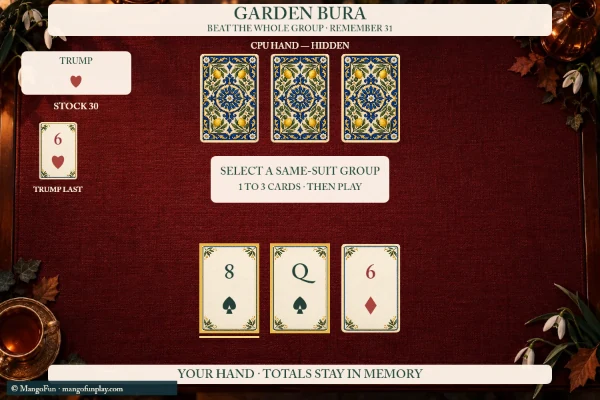
Play the Bura card game on an illustrated burgundy garden table. Lead several cards together, decide which tricks are worth taking, and remember when your captured points reach 31. Garden Bura combines a complete memory practice deal against the CPU with twenty original open planning studies. Play free online with no ads or download.
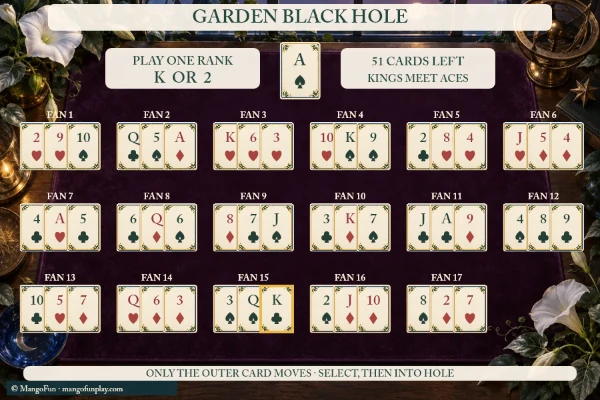
Play Black Hole Solitaire on an illustrated moonlit garden table. Seventeen open fans feed one central pile, one adjacent rank at a time. Garden Black Hole follows David Parlett's original single-deck rule profile and adds twenty original planning studies with exact explanations. Play free online with no ads or download.
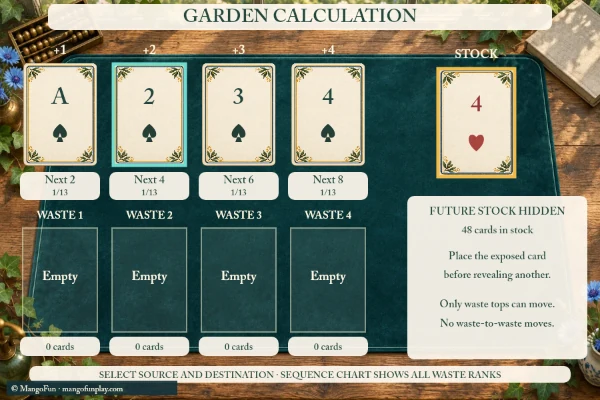
Play Calculation Solitaire on an illustrated teal garden table. Build four foundations by different rank intervals while planning where each stock card should wait. Garden Calculation includes full deals and twenty original open-stock studies with exact hint explanations. Play free online with no ads or download.
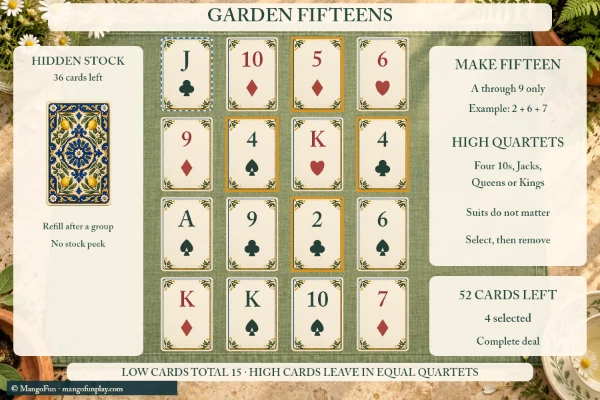
Play Fifteens Solitaire with illustrated cards on a chamomile garden table. Combine low cards to make fifteen, clear four equal high cards, and keep space for the next refill. Garden Fifteens uses the standard sum-and-quartet rules described below, with complete deals and twenty original planning studies. Play free online with no ads or download.