Practice the Chinchon card game at a garden table with clear draw, discard and close controls. This two-player version uses 40 cards without jokers and a 70-point elimination limit. Play complete CPU matches or work through 20 open-information meld studies. It is free to play with no ads or download.
Draw one card from the stock or take the top discard. You now have eight cards and must select exactly one to discard.
Build sets of three or four equal ranks, or runs of at least three consecutive cards in the same suit. A is low, and 7 is followed by J in this 40-card deck.
After the first circuit, Close your hand if all seven remaining cards are melded, or six are melded and the single unmatched card is worth at most 4. Otherwise discard normally and continue.
Controls
Tap a card to select your discard after drawing. Close hand uses the displayed closing layout; Arrange cycles alternatives when available. Keys 1–8 select, arrows move focus, and Enter or Space selects. S draws stock, T takes the top discard, D discards, C closes, A arranges, H hints, U or Ctrl+Z undoes, and N starts the next hand. Help and Melds & scores open separate dialogs.
A tip before you start
A card can fit more than one plan. Keeping a 4 beside a 2 and 3 may help a suited run, while saving it beside other 4s supports a set. Before closing six cards, inspect which ends of your runs the opponent might extend. A different legal layout can change their layoff opportunities.
The 40-card, no-joker table
Each suit contains A, 2, 3, 4, 5, 6, 7, J, Q and K. This table displays familiar clubs, diamonds, spades and hearts instead of Spanish suit artwork. Each player receives seven cards, one discard is exposed, and 25 remain in the stock. The non-dealer begins; the dealer changes after every hand. Draw first and discard second. Closing is unavailable until both players have completed their opening turn.
Runs, sets and a legal close
A set needs three or four cards of one rank. A run needs at least three consecutive cards of one suit; 7–J–Q is consecutive here, while Q–K–A is not. To close, select your discard and leave either seven melded cards or six melded cards with one unmatched A, 2, 3 or 4. Courts count as 10 points. A positive closing score cannot take your own accumulated score above 70.
Choose the closing layout before committing
Some hands have more than one valid arrangement. After selecting a discard, Arrange cycles the eligible closing layouts. The preview shows the exact groups, with C, D, S and H standing for clubs, diamonds, spades and hearts. Melds & scores expands the card names. Close hand commits that displayed arrangement; Discard card continues the hand without closing.
Scoring and laying off unmatched cards
A six-card closer scores the value of their unmatched card. The other player arranges their own melds, then minimizes their remaining points by laying eligible unmatched cards onto the closer's exposed groups. A run can grow through consecutive attachments; a rank set stops at four. Closing all seven suppresses these layoffs. Closing a three-card and four-card meld scores minus 10; a natural seven-card suited run wins the whole match.
The opponent's hand and the 70-point limit
The nonclosing player scores their remaining unmatched cards after any permitted layoffs. Their own seven-card meld scores zero, without the closer's bonus or instant match win. A player whose accumulated score exceeds 70 is eliminated. The scoring dialog records both sets of melds, laid-off cards, unmatched cards and point changes, so you can see why a hand scored as it did.
Stock recycling and declared edge rules
When the stock empties, the top discard stays visible while older discards are shuffled to refill it. This browser profile ends a hand on the fourth stock exhaustion after the current draw and discard, unless a legal close was selected first. A forced hand scores each player's best own melds without layoffs or closing bonuses. If both totals exceed 70, the lower total wins; equal totals continue to another hand. These edge choices are stated explicitly because Chinchon tables vary.
Twenty studies with increasing planning demands
Each study begins at a position reached by legal play. Both hands and the entire stock order are public in Melds & scores. Make your own successful close within the displayed number of complete draw-and-discard turns. The shortest plans grow from one to three turns, and reachable decision states increase at every level. The opponent follows the same fixed CPU policy throughout. These are planning puzzles against that policy, not a promise of success against every possible human reply.
Computer play, hints and saved progress
A normal match hides the opponent's cards and future stock. The CPU uses its own hand and public information. Match hints follow that same beatable policy. Study hints can inspect the disclosed stock and search for a closing continuation; a search limit is reported as unknown. Two successful study hints are available and Undo does not refund them. Undo restores a whole turn and the CPU reply, including a partial draw or the same next-hand deal. Confirmed Restart repeats the seed; New match changes it. Only unlocked studies, best results and sound preference save locally; unfinished matches restart after reloading.
Frequently asked questions
Is this a joker version of Chinchon?
No. It uses 40 cards without jokers. Other tables may use 48 or 50 cards, different closing limits, different penalties or reentry. The rules described here apply to this game.
Why can I not close with a 5 left over?
This chosen profile allows only a single unmatched card worth 1–4, after the first circuit. A 5 is outside that limit. You can also close with all seven cards melded.
Can I close immediately after the deal?
No. You draw and discard on your opening turn, but neither player may close until both have completed that first circuit.
Why does 7 connect directly to J?
The deck has no 8 or 9. Its sequence is A through 7, then J, Q and K. All three court cards are worth 10 for unmatched-card scoring.
Why did the opponent get to add cards to my run?
A six-card close allows the opponent to lay unmatched cards onto your displayed melds after forming their own groups. Closing all seven prevents those layoffs.
Does every seven-card meld win the match?
Only a natural seven-card suited run chosen by the closer wins the match immediately. A closer's separate three-card and four-card meld scores minus 10 instead.
Can I play another person online?
This version offers a computer opponent and solo studies. It has no remote rooms, real-money stakes or reentry system.
About Garden Chinchon
Practice the Chinchon card game at a garden table with clear draw, discard and close controls. This two-player version uses 40 cards without jokers and a 70-point elimination limit. Play complete CPU matches or work through 20 open-information meld studies. It is free to play with no ads or download.
Play this puzzle / casual game in the embedded browser player. No app installation or MangoFun account is required. Follow the instructions shown inside the game; controls and device support depend on the title.
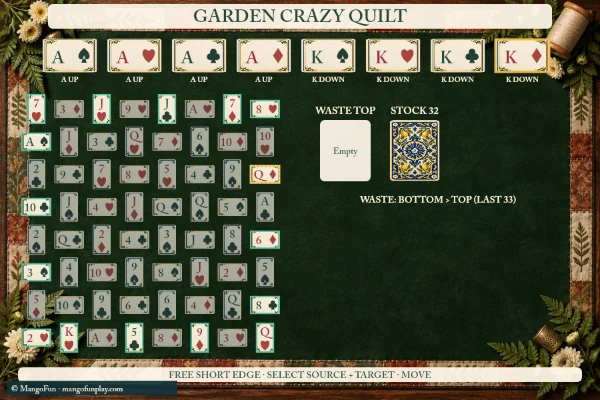
Play Crazy Quilt Solitaire on an illustrated garden table with a hand-sewn patchwork border. Sixty-four cards form a woven layout whose short edges control every move. Garden Crazy Quilt combines the full two-deck game with twenty original endgame studies about waste order, stock draws and the cards still in the quilt. Play free online with no ads or download.
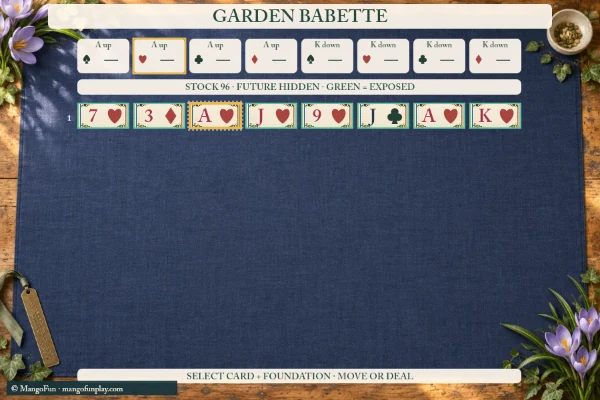
Play Babette Solitaire on an illustrated indigo garden table. Two decks feed eight suit foundations through aligned rows with lasting gaps. Garden Babette adds twenty original planning studies that compare moving a card with dealing the next row. Play free online with no ads or download.
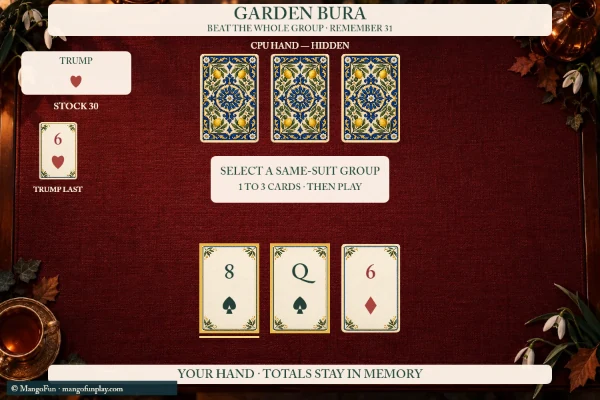
Play the Bura card game on an illustrated burgundy garden table. Lead several cards together, decide which tricks are worth taking, and remember when your captured points reach 31. Garden Bura combines a complete memory practice deal against the CPU with twenty original open planning studies. Play free online with no ads or download.
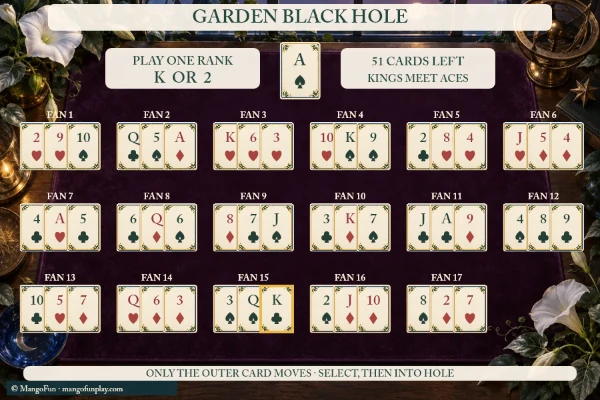
Play Black Hole Solitaire on an illustrated moonlit garden table. Seventeen open fans feed one central pile, one adjacent rank at a time. Garden Black Hole follows David Parlett's original single-deck rule profile and adds twenty original planning studies with exact explanations. Play free online with no ads or download.
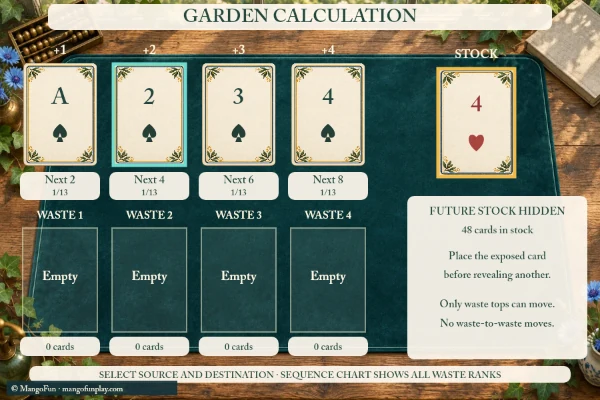
Play Calculation Solitaire on an illustrated teal garden table. Build four foundations by different rank intervals while planning where each stock card should wait. Garden Calculation includes full deals and twenty original open-stock studies with exact hint explanations. Play free online with no ads or download.
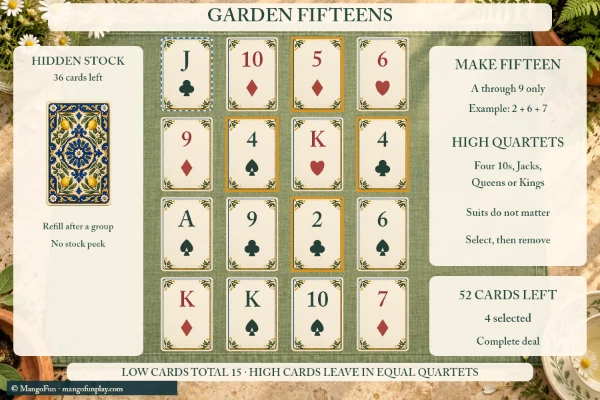
Play Fifteens Solitaire with illustrated cards on a chamomile garden table. Combine low cards to make fifteen, clear four equal high cards, and keep space for the next refill. Garden Fifteens uses the standard sum-and-quartet rules described below, with complete deals and twenty original planning studies. Play free online with no ads or download.