Play a Yaniv card game online and learn when a low hand is safe to call. Discard a single card, set or run, draw one replacement and keep track of what the computer picks up. Garden Yaniv includes a complete two-player match and 20 open-information studies. Play free with no ads or download.
Each player receives five cards from a 54-card deck. Aces score 1, numbered cards their value, courts 10 and jokers 0. Keep your hand total low.
Select a discard group in order, then choose the stock or an endpoint of the previous discard group. You always discard before drawing exactly one card.
At the start of your turn, call Yaniv with 5 points or fewer if you think your hand is strictly lower. A tied or lower opponent catches the call with Asaf.
Controls
Tap cards in the order you want to discard them. Selection badges show that order; Arrange group cycles legal arrangements of the same cards. Choose Discard → Stock, Left or Right to complete the turn. Arrow keys move focus and Space or Enter selects. Escape clears, A arranges, S draws stock after discarding, L/R take the old group endpoint, Y calls, H hints and U or Ctrl+Z undoes. Score, help, pause, sound, restart and fullscreen controls are available.
A tip before you start
Calling with 5 is legal but not automatically safe: an equal total catches you. Watch the opponent's hand size and public pickups. A set or run can remove several high cards at once, but its exposed endpoints give the next player a choice. The low-scoring joker is especially valuable when left at a run's end.
Yaniv card game rules for this table
This is a declared two-player, 54-card profile with five-card starting hands and a five-point calling limit. On your turn either call, if eligible, or discard one legal group and draw one card. A single card is always a group. A natural set contains two or more cards of the same rank. A run contains at least three cards of one suit in ascending rank order, with ace low. Queen-king-ace does not form a run.
Jokers, ordering and the two available ends
Jokers score zero and can replace missing cards inside a run or at its ends. In this profile they are not wild in sets, and two jokers alone are not a set. Select your cards in their intended discard order; Arrange group offers other legal arrangements where possible. The next player may take only the first or last card of that group. Middle cards stay unavailable, even when they belong to a same-rank set.
Discard first, then pick up one card
You draw exactly one card even after discarding several. The face-up pickup choices belong to the previous player's group, not the cards you are now discarding. The stock is the alternative blind draw. If it runs out, the older discarded cards are shuffled into a new stock while the newly discarded group stays face up. A draw completes your turn, so a newly low hand must wait until your next turn to call.
The five-point call and Asaf
You may call only at the start of your own turn with a hand total of 5 or less. Both hands are then revealed. If yours is strictly lower, you add zero to your match score. If the opponent is equal or lower, you add your hand total plus 30: the Asaf penalty. The opponent always adds their own hand value. Calling is optional; you may keep playing even when eligible.
Round scores, reductions and the match winner
Low cumulative score is good. Positive round points landing exactly on 100 reduce that total to 50; landing on 200 reduces it to 100. Apply one reduction, and do not trigger another after a zero-point round. Above 200 is eliminated. If both final players cross the limit together, the lower score wins; if tied, this table plays another round. These explicit edge choices avoid an unresolved finish. The lowest hand from the round starts next; a tied hand gives that right to the other seat clockwise from the caller. The initial starter is random.
Twenty open-information studies
Each study starts from a legal deal and recorded sequence of turns. Both hands are visible, and Study stock & rules lists the entire stock from top to bottom. Make your own successful call within the stated decision budget, counting the call itself. The minimum required decisions grow from one to four, with larger hands, more initial options and strictly more reachable decision states. The CPU follows the same declared public-information policy. This is planning with disclosed cards, not a claim to solve hidden-information Yaniv.
Fair computer play and optional hints
In a full match, the computer receives its own hand, public discards, hand counts and scores. It does not receive your card identities or the stock order. Its advice favors lower hand value and avoids endlessly exchanging visible cards without improvement. Study hints search the disclosed position within a limit; no result means the bounded search found none, not that the position is proven lost. Two successful study hints are available, and Undo does not refund them.
Undo, saved progress and rule variations
Undo restores your entire decision and any following CPU turn, including shuffle randomness. Restart repeats the match seed after confirmation, while New match uses a new seed. Challenge unlocks, best study results and sound preferences save on this device when storage is available; unfinished matches restart on reload. This version does not include slam-down, requests for another player's card, a seven-point calling limit or draw-first house rules. It has no remote multiplayer or cash stakes.
Frequently asked questions
Can I call Yaniv immediately after drawing a low card?
No. Drawing ends your turn. Wait until the start of your next turn, and call only if your total is still 5 or less.
Does a tied hand beat the caller?
Yes. The caller must be strictly lower. A tie causes Asaf, so the caller adds their hand value plus 30.
Can I take the middle card of a discarded set?
Not at this table. Only the first or last card of the previous group is available, for sets as well as runs.
May I pick up a card I just discarded?
No. A face-up pickup comes from the previous group. Your new group becomes the next player's choice.
Do I win by discarding my entire hand?
No. You still draw one replacement, so the hand is not empty after the turn. End a round with a legal call at the start of a later turn.
Are the studies played with hidden cards?
No. They deliberately reveal both hands and the full stock order. Choose a full CPU match for normal hidden hands and blind stock draws.
Can score reductions happen twice at once?
No. At this table, positive added points can trigger one reduction. A score of 200 becomes 100 without immediately becoming 50; a following zero-point round leaves it unchanged.
About Garden Yaniv
Play a Yaniv card game online and learn when a low hand is safe to call. Discard a single card, set or run, draw one replacement and keep track of what the computer picks up. Garden Yaniv includes a complete two-player match and 20 open-information studies. Play free with no ads or download.
Play this puzzle / casual game in the embedded browser player. No app installation or MangoFun account is required. Follow the instructions shown inside the game; controls and device support depend on the title.
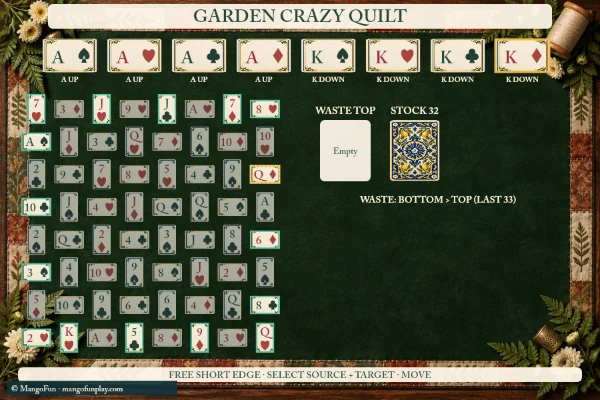
Play Crazy Quilt Solitaire on an illustrated garden table with a hand-sewn patchwork border. Sixty-four cards form a woven layout whose short edges control every move. Garden Crazy Quilt combines the full two-deck game with twenty original endgame studies about waste order, stock draws and the cards still in the quilt. Play free online with no ads or download.
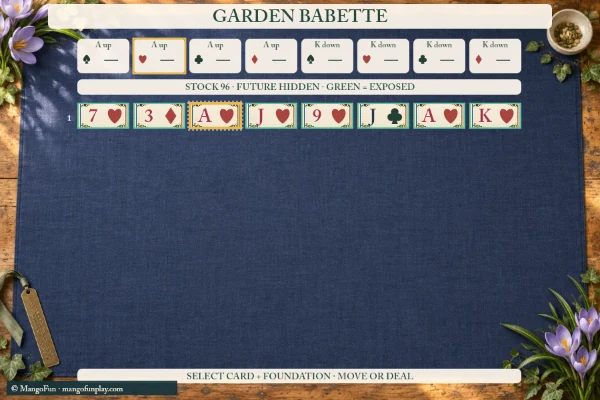
Play Babette Solitaire on an illustrated indigo garden table. Two decks feed eight suit foundations through aligned rows with lasting gaps. Garden Babette adds twenty original planning studies that compare moving a card with dealing the next row. Play free online with no ads or download.
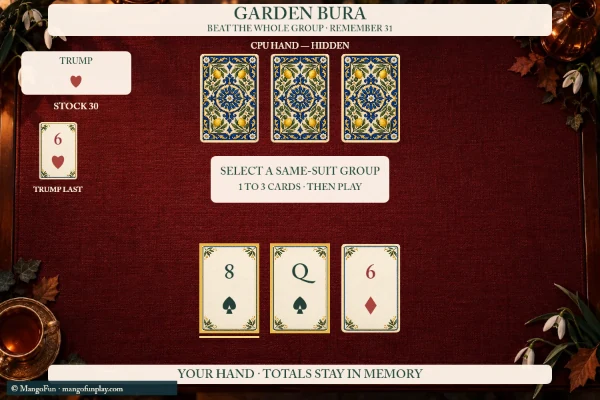
Play the Bura card game on an illustrated burgundy garden table. Lead several cards together, decide which tricks are worth taking, and remember when your captured points reach 31. Garden Bura combines a complete memory practice deal against the CPU with twenty original open planning studies. Play free online with no ads or download.
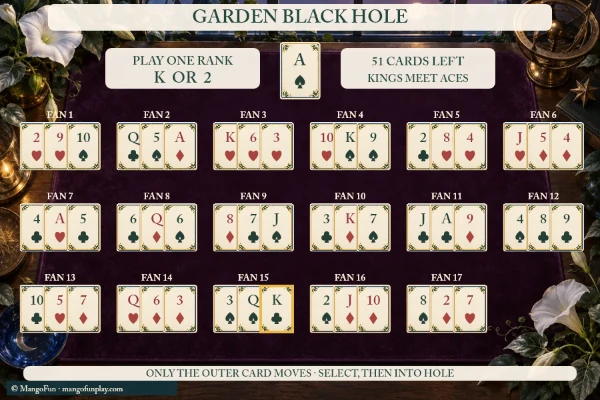
Play Black Hole Solitaire on an illustrated moonlit garden table. Seventeen open fans feed one central pile, one adjacent rank at a time. Garden Black Hole follows David Parlett's original single-deck rule profile and adds twenty original planning studies with exact explanations. Play free online with no ads or download.
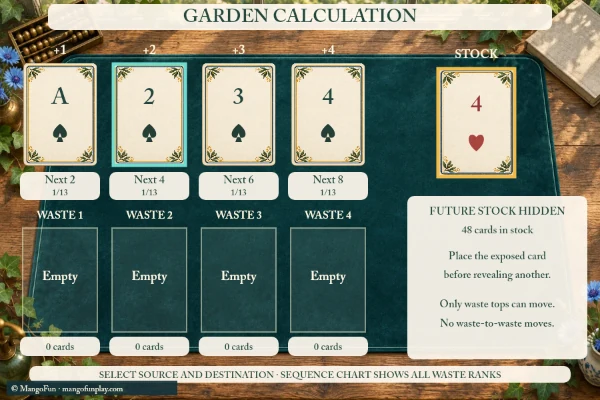
Play Calculation Solitaire on an illustrated teal garden table. Build four foundations by different rank intervals while planning where each stock card should wait. Garden Calculation includes full deals and twenty original open-stock studies with exact hint explanations. Play free online with no ads or download.
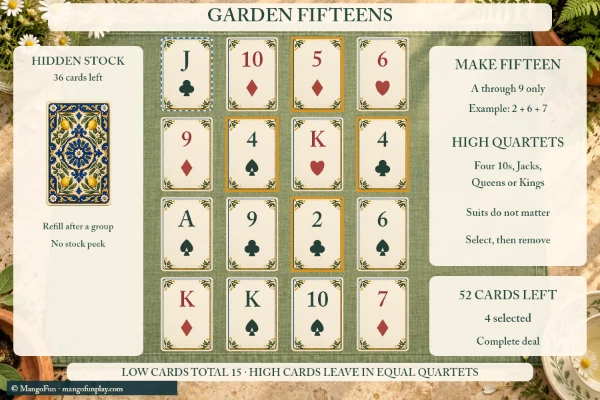
Play Fifteens Solitaire with illustrated cards on a chamomile garden table. Combine low cards to make fifteen, clear four equal high cards, and keep space for the next refill. Garden Fifteens uses the standard sum-and-quartet rules described below, with complete deals and twenty original planning studies. Play free online with no ads or download.