Play the Cuarenta card game at a garden table, choosing between matching ranks, adding numbered cards and leaving a deliberate drop. This two-player teaching version offers complete CPU matches to 40 points and 20 open-hand capture studies. It is free to play with no ads or download.
Select one of your five hand cards. To capture, choose one equal-rank table card or numbered cards whose values add to yours. You may also drop the card without capturing.
Inspect the gold base and teal continuation. The game adds one card of each consecutive higher rank, stopping at a gap; J follows 7. Press Capture to commit, or Drop card to leave your card on the table.
Score caida, limpia, eligible automatic ronda and end-of-deck carton points. Reach 40 to win the CPU match, or meet a study's additional-capture target after all remaining cards are played.
Controls
Tap a hand card, then the table cards forming its base. The two Capture arrow buttons cycle all legal bases, which also helps when the table is crowded. Capture commits the preview; Drop card never captures. Keys 1–5 select, arrows move focus, Enter or Space selects, P captures, D drops, A/B cycles captures, H hints, U or Ctrl+Z undoes, N starts the next deck and Escape clears selection. Score & rules and Help open separate dialogs.
A tip before you start
An immediate match is not always the best plan. A sum can open a longer ascending capture, while a deliberate drop can prepare your next card. Watch the red outline: caida requires directly matching that exact previous drop, not merely collecting it in an addition or higher run.
How to play Cuarenta at this table
The deck has four suits of A, 2, 3, 4, 5, 6, 7, J, Q and K. Suits are cosmetic. Each player receives five cards, with four batches completing a deck. The non-dealer receives cards first and begins every batch. The table starts empty; after a completed deck, the dealer changes. A match can span several decks.
Cuarenta card game rules: choosing a capture
A matching base contains one table card of the same rank as your played card. An addition base contains at least two numbered cards summing to its value. A counts as 1, and only A through 7 participate in addition; J, Q and K cannot be added. After either base, take one copy of each consecutive higher rank. For example, playing 7 onto a legal base can collect J, then Q, then K. A missing rank stops the run. Duplicate ranks do not all disappear.
Drop remains a real choice
This profile allows a drop even when a capture is available. The separate Drop card button makes that decision explicit. The preview shows only what Capture would take. Selecting an incomplete or invalid sum does not spend a turn, and you can clear the base or cancel before committing. The computer and study solver follow the same optional-drop rule.
Caida, limpia and the 38-point boundary
Directly matching the opponent's immediately previous dropped card earns 2 for caida. Clearing the table earns 2 for limpia, including on the final card of a deck. A player already on 38 receives no limpia points; caida still scores. From 36, a combined caida and limpia gives 4 and wins. Previous-drop eligibility resets when a new five-card batch is dealt.
Automatic ronda and the declared teaching version
Three equal ranks in a fresh hand automatically score 4 for ronda only when that player's score is below 30. Four equal ranks win the match immediately. If both hands contain four of a kind, the deck is void and Next deck redeals at unchanged scores with the same dealer. This two-player teaching adaptation uses the basic Pagat capture, count and 38-point framework. It omits the advanced remembered-ronda ten-point bonus, physical misdeal and forgotten-capture penalties, and partnership rules. Other tables differ; the rules here describe this implementation.
Counting captured cards at the end
Unclaimed table cards belong to neither player. Capturing 20 cards earns 6 carton points; add one for each card above 20, then round the result up to an even number. A pile of 21 or 22 therefore earns 8. If both piles contain exactly 20, only the non-dealer receives 6. When neither reaches 20, the larger pile receives 2; tied piles award 2 to the non-dealer. Carton may take a player from 38 to a winning score in this profile.
Twenty studies with increasing planning demands
Every study starts from a position reached through legal play. Both final hands are visible, and there is no remaining stock. Finish the cards while guaranteeing the displayed number of additional captures against every legal reply. Ordinary point totals do not stop these exercises, and table leftovers do not count. Later studies increase meaningful decision states and planning depth, from two-card endings to four-card plans. Optional drops and every legal capture base remain part of the search.
Hints, Undo and saved progress
Normal CPU play and match advice use only that player's own hand and public information. Study hints may inspect the disclosed hands and preserve the capture target against all replies; a search limit is reported as unknown. Two successful hints are available per study, and Undo does not refund them. Undo restores your complete turn and the CPU reply, including the same next-deck deal. Confirmed Restart repeats the seed, while New match changes it. Only unlocks, best results and sound preferences save locally; unfinished matches restart after reload.
Frequently asked questions
Must I capture when I have a matching card?
No. This table explicitly permits an optional drop, even when a legal match or sum exists. Use Drop card to make that choice.
Why did only one of two equal table cards get collected?
A matching base uses one equal-rank card, and each higher continuation rank contributes one copy. You can cycle base alternatives before committing; duplicate continuation copies use a fixed representative.
Can I add face cards together?
No. Addition uses only A through 7. Face cards can be matched or collected in a higher consecutive run, with J directly following 7.
How does this game teach the rules?
You can open Help or Score & rules, review the exact capture preview, use Undo and play 20 progressively harder open-hand studies. The full match keeps the computer's hand hidden.
Why did my sweep score nothing on 38?
This profile suppresses limpia when you already have 38 points. Caida and end-of-deck carton can still win the match. Some other Cuarenta versions apply different restrictions.
Is this remote multiplayer?
This version provides a computer opponent and solo studies. It has no remote rooms, cash stakes or in-game ads.
About Garden Cuarenta
Play the Cuarenta card game at a garden table, choosing between matching ranks, adding numbered cards and leaving a deliberate drop. This two-player teaching version offers complete CPU matches to 40 points and 20 open-hand capture studies. It is free to play with no ads or download.
Play this puzzle / casual game in the embedded browser player. No app installation or MangoFun account is required. Follow the instructions shown inside the game; controls and device support depend on the title.
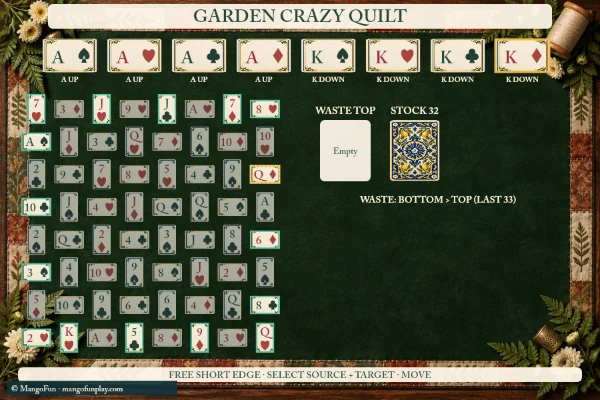
Play Crazy Quilt Solitaire on an illustrated garden table with a hand-sewn patchwork border. Sixty-four cards form a woven layout whose short edges control every move. Garden Crazy Quilt combines the full two-deck game with twenty original endgame studies about waste order, stock draws and the cards still in the quilt. Play free online with no ads or download.
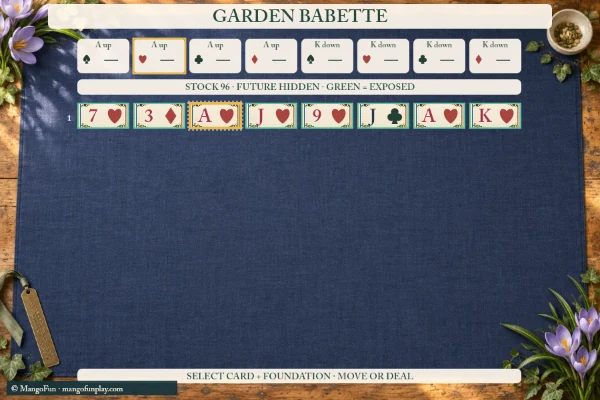
Play Babette Solitaire on an illustrated indigo garden table. Two decks feed eight suit foundations through aligned rows with lasting gaps. Garden Babette adds twenty original planning studies that compare moving a card with dealing the next row. Play free online with no ads or download.
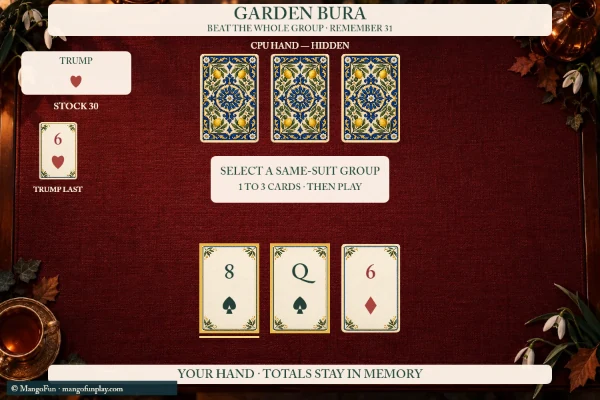
Play the Bura card game on an illustrated burgundy garden table. Lead several cards together, decide which tricks are worth taking, and remember when your captured points reach 31. Garden Bura combines a complete memory practice deal against the CPU with twenty original open planning studies. Play free online with no ads or download.
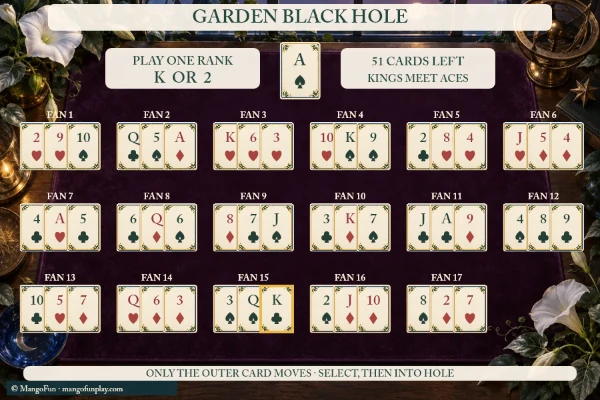
Play Black Hole Solitaire on an illustrated moonlit garden table. Seventeen open fans feed one central pile, one adjacent rank at a time. Garden Black Hole follows David Parlett's original single-deck rule profile and adds twenty original planning studies with exact explanations. Play free online with no ads or download.
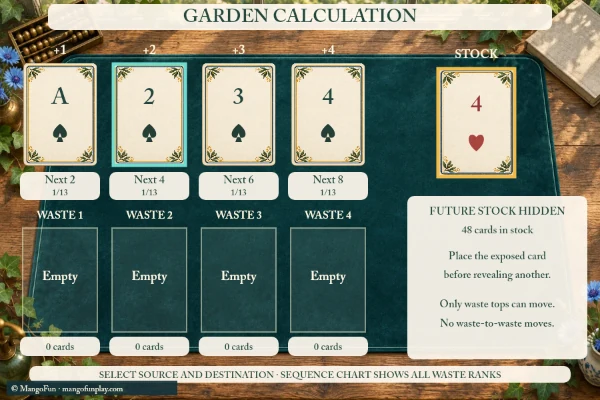
Play Calculation Solitaire on an illustrated teal garden table. Build four foundations by different rank intervals while planning where each stock card should wait. Garden Calculation includes full deals and twenty original open-stock studies with exact hint explanations. Play free online with no ads or download.
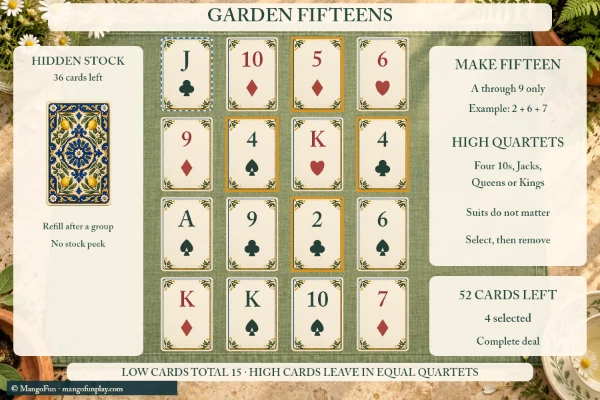
Play Fifteens Solitaire with illustrated cards on a chamomile garden table. Combine low cards to make fifteen, clear four equal high cards, and keep space for the next refill. Garden Fifteens uses the standard sum-and-quartet rules described below, with complete deals and twenty original planning studies. Play free online with no ads or download.